

Updated Mar 30, 2026 Verified L5M5 dumps Q&As - 100% Pass
New 2026 Latest Questions L5M5 Dumps - Use Updated CIPS Exam
CIPS L5M5 Exam Syllabus Topics:
| Topic | Details |
|---|---|
| Topic 1 |
|
| Topic 2 |
|
| Topic 3 |
|
NEW QUESTION # 42
Which of the following statements highlights a key limitation of direct trade that critics argue weakens its ability to ensure ethical practices?
- A. Direct trade removes the need for third-party certifications, guaranteeing full transparency in all cases
- B. Power imbalances between producers and buyers are completely eliminated through direct trade agreements
- C. The lack of standardized criteria in direct trade allows companies to define ethical practices on their own, potentially resulting in inconsistent or misleading claims
- D. Direct trade enforces strict regulations to ensure fair wages for all workers, including temporary laborers
Answer: C
Explanation:
Choice B - This is correct because one of the primary criticisms of direct trade is the lack of universal standards. Companies can define "ethical practices" in their own terms, which may vary widely and lead to confusion or even greenwashing.
Choice A - This is incorrect because while direct trade does not rely on third-party certifications, this does not ensure complete transparency. In fact, the lack of third-party oversight is often criticized as a limitation, as it can lead to inconsistent or unverifiable claims.
Choice C - This is incorrect because direct trade does not guarantee fair wages for all workers, especially temporary or seasonal laborers. The focus is typically on producers or cooperatives, leaving other workers vulnerable to exploitation.
Choice D- This is incorrect because power imbalances can still exist in direct trade relationships. Buyers may hold significant leverage, particularly if producers depend on them as their sole buyer. Direct trade does not inherently eliminate these imbalances.
Reference:
LO-3.3; Page 309-310; Fairtrade standards that affect the workplace and producers and their implications for procurement and supply
NEW QUESTION # 43
The World Fair Trade Organization (WFTO) aims to help large global businesses expand into new markets, offering better products and fairer prices for consumers. Is this statement accurate?
- A. Yes, the WFTO establishes global rules to safeguard consumers
- B. No, the WFTO focuses on supporting smaller and disadvantaged producers
- C. Yes, the WFTO provides financial aid to international companies
- D. No, the WFTO primarily focuses on diminishing the influence of multinational corporations
Answer: B
Explanation:
Choice C- This is correct. The WFTO's mission is to support small and disadvantaged producers, ensuring fair wages, ethical trade practices, and market access.
Incorrect answer:
Choice A- This is incorrect. The WFTO does not focus on diminishing multinational corporations but works to empower disadvantaged producers.
Choice B- The WFTO does not establish global regulations but promotes fair trade practices and ethical business standards for producers and consumers, therefore this is wrong.
Choice D- This is incorrect. The WFTO's mission does not involve providing financial aid to businesses; it focuses on promoting fair trade principles.
Reference:
LO-3.3; Page 294-295; The World Fair Trade Organization (WFTO) and its principles
NEW QUESTION # 44
Which of the following are regarded as potential benefits of responsible procurement?
1. Reduction of staff retention for the organization
2. Enhanced business reputation and social improvements
3. Increased operational risks due to supplier diversity
4. Cost savings due to the application of lifecycle costing
- A. 1 and 2
- B. 4 and 1
- C. 2 and 3
- D. 2 and 4
Answer: A
Explanation:
Choice 2- Selecting sustainable good and services from responsible suppliers creates a positive reputation, and social improvements increase therefore a business attracts new customers.
Choice 4- Responsible procurement uses life cycle costing which considers the whole life span of a product rather than the initial purchase cost only. Thus is more cost effective because costs that arise throughout the product's life are also taken into account.
Incorrect answer:
Choice 1- Responsible procurement shows commitment to long term environmental and social issues which helps to retain employees and attract new employees. Employees want to be associated with such business which are investing in the future and makes employees more motivated. Therefore choice 1 is the wrong choice.
Choice 3-This is not a benefit. While engaging a diverse supplier base can introduce complexity, it typically enhances resilience rather than increasing risks.
Reference:
LO-1.1; Page 10; Analyze the application of ethical and ESG (Environmental, Social and Governance) factors in supple chains
NEW QUESTION # 45
EcoSmart Solutions, a company specializing in sustainable construction materials, intends to make a sustainability claim for their product. They are aware of the ISEAL Alliance's guidelines for valid sustainability claims. Which of the following would be considered a valid sustainability claim according to ISEAL Alliance standards?
- A. The product reduces carbon emissions, but the claim is not supported by any third-party audits or verifications
- B. The product is made using 100% recycled materials, with claims verified by third-party certification from a recognized sustainability standard
- C. The product claims to improve sustainability, but the claims are solely based on anecdotal evidence and not on any recognized environmental criteria or certification
- D. The product is marketed as "eco-friendly" based on internal environmental policies without any external certification
Answer: B
Explanation:
Choice A- This is the correct answer. According to ISEAL Alliance guidelines, a valid sustainability claim must be supported by third-party certification from a credible and recognized sustainability standard, ensuring the claim is verifiable and transparent.
Incorrect answer:
Choice B- This is not a valid claim under ISEAL guidelines because third-party verification is necessary to substantiate any claims related to carbon emissions.
Choice C- This is not a valid claim under ISEAL guidelines. Claims need to be independently verified, and internal policies alone do not provide credibility to the sustainability claim.
Choice D- This is not a valid claim according to ISEAL standards. Claims should be based on verifiable evidence and supported by recognized sustainability standards.
Reference:
LO-3.2; Page 291; Role of industry standards and frameworks used by organizations in securing ESG considerations and ethical standards and Charter of Fair Trade and implications for procurement and supply
NEW QUESTION # 46
Which of the following could be considered a bribe? Select TWO
- A. A buyer sends a gift basket to a supplier at Christmas
- B. A supplier bidding on a tender invites the buyer to play golf
- C. An agricultural organisation donates to a politician to vote in a certain way
- D. A company pays an invoice two days early
Answer: B,C
Explanation:
Comprehensive and Detailed Explanation From Exact Extract of Documents:
Bribery involves offering something of value to influence decision-making improperly. According to the L5M5 study guide (p.47), inviting a buyer to play golf during a tender (A) and donating to a politician to influence voting (B) are clear examples of bribery. A Christmas gift (C) may sometimes be considered borderline depending on company policies, but it is generally not categorised as bribery unless intended to influence. Paying invoices early (D) is not bribery. Procurement professionals must comply with anti-bribery policies and legislation such as the UK Bribery Act to maintain integrity.
Reference: Managing Ethical Procurement and Supply (L5M5) Study Guide, p.47
NEW QUESTION # 47
What is the term for a clause in a contract that, if breached, allows the injured party to claim damages but does not result in the termination of the contract?
- A. Condition
- B. Warranty
- C. Representation
- D. Innominate term
Answer: B
Explanation:
Choice C- A warranty in a contract is a term that, if breached, allows the injured party to claim damages but does not give them the right to terminate the entire contract. Therefore, this is the answer.
Incorrect answer:
Choice A- A representation is a statement made by one party to another, often during pre-contractual negotiations, to induce them to enter into a contract. Representations are not terms of the contract, so their breach does not directly impact the contract itself in the same way as a condition, warranty, or innominate term. Since the question specifies a contractual clause, representation cannot be the correct answer.
Choice B- A condition is a fundamental term of the contract. Breaching a condition gives the injured party the right to: Terminate the contract, and Claim damages. The question explicitly states that the clause should not allow for termination of the contract. Therefore, a condition does not fit the criteria.
Choice D- An innominate term does not have a predefined classification as a condition or warranty. Its treatment depends on the severity of the breach: If the breach is serious, it could lead to termination (similar to a condition) or if the breach is minor, it only results in damages (similar to a warranty). Since the question specifies a clause that does not allow for termination regardless of the breach's impact, this term is too flexible to be the correct answer.
Reference:
LO-2.2; Page 190-191; Monitoring Contract Performance
NEW QUESTION # 48
Which of the following are core Labour Standards of the ILO? Select TWO
- A. Payment of a living wage
- B. Freedom of association
- C. Equal opportunities for all
- D. Protection from job insecurity
Answer: A,B
Explanation:
Comprehensive and Detailed Explanation From Exact Extract of Documents:
The International Labour Organisation (ILO) has defined core labour standards. According to the L5M5 study guide (old p.60, new p.88), these include freedom of association (A) and payment of a living wage (B). Other standards include the right to unionise, elimination of forced labour, and restriction of child labour. Equal opportunities (C) and protection from job insecurity (D) are important labour rights but not classified as core ILO standards. Procurement professionals must ensure suppliers comply with these standards to avoid reputational, legal, and operational risks.
Reference: Managing Ethical Procurement and Supply (L5M5) Study Guide, p.88
NEW QUESTION # 49
Nahid Cotton Mills Ltd, a leading manufacturer and exporter of high-quality knitting and cotton yarn in Bangladesh, aims to expand internationally and grow its global market to increase profits. The STEEPLED analysis tool can help assess various macro-environmental factors affecting the business. Which of the following factors fall under the social element of this analysis?
- A. Level of corruption and bribery present
- B. Fashion and trends led by local celebrities
- C. Inflation and interest rates
- D. Waste management initiatives
Answer: B
Explanation: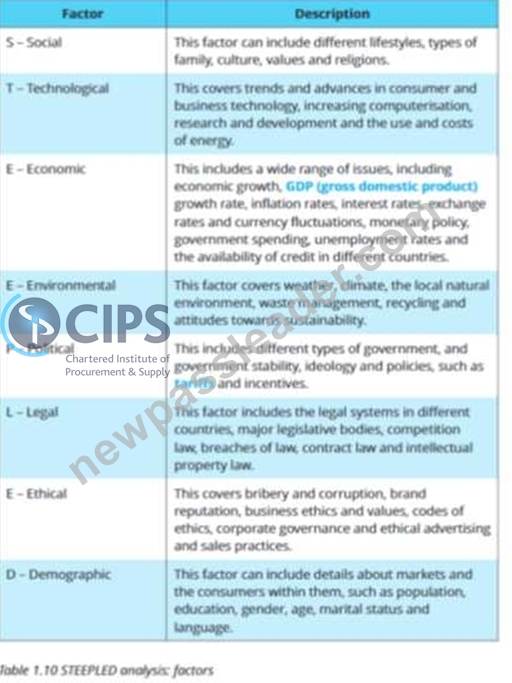
Choice A- Waste management initiatives is an Environmental factor. Choice B- Fashion and trend led by celebrities is a social factor as a it includes different lifestyles, types of family, culture, values and religions. Therefore is the correct answer. Choice C- Is an economic factor. Choice D- Corruption and bribery is a part of government idealogy and policies thus is a political factor. Reference: LO-1.2; Page 55; Use of STEEPLED analysis to explain the factors driving globalization
NEW QUESTION # 50
Knowledge that is not taught or learned from books but gained through personal experience is known as what?
- A. Primary knowledge
- B. Tacit knowledge
- C. Implied knowledge
- D. Inherent knowledge
Answer: B
Explanation:
Comprehensive and Detailed Explanation From Exact Extract of Documents:
The L5M5 study guide (old p.40, new p.64) defines tacit knowledge as knowledge gained through personal experience, observation, and practice rather than formal education. For example, an employee may develop an instinct for supplier negotiation strategies over years of practice. By contrast, explicit knowledge can be formally recorded and taught. Tacit knowledge provides competitive advantage because it is harder for competitors to imitate. Procurement leaders must capture and share tacit knowledge within teams to strengthen organisational learning.
Reference: Managing Ethical Procurement and Supply (L5M5) Study Guide, p.64
NEW QUESTION # 51
Which of the following is an example of an organisation updating an internal governance standard?
- A. A construction company begins to pay subcontractors the living wage
- B. An IT provider updates an SOP to reflect a new version of cyber security software
- C. A manufacturer achieves ISO 9001 for the first time
- D. Shareholders at a publishing house receive an additional dividend
Answer: B
Explanation:
Comprehensive and Detailed Explanation From Exact Extract of Documents:
Internal governance standards are the policies, procedures, and practices that guide how an organisation operates internally. According to the L5M5 study guide (p.313), updating a Standard Operating Procedure (SOP) is an example of strengthening internal governance. This ensures compliance, consistency, and risk management within an organisation's operations. By contrast, achieving ISO 9001 (A) involves external certification, paying a living wage (C) relates to external social responsibility, and paying dividends (D) relates to shareholder rewards, not governance. Procurement professionals must understand governance frameworks because robust internal governance ensures compliance with ethical procurement standards and reduces risks of malpractice.
Reference: Managing Ethical Procurement and Supply (L5M5) Study Guide, p.313
NEW QUESTION # 52
A procurement officer at a global retail company is responsible for sourcing raw materials for a new product line. With the company committed to ethical sourcing practices, including Fair Trade, the officer aims to clearly communicate Fair Trade requirements to potential suppliers. Where should these requirements be included to ensure compliance?
- A. In internal emails to the procurement team
- B. In the specifications section of the tender document
- C. During supplier performance review meetings after contracts are signed
- D. In the company's annual sustainability report
Answer: B
Explanation:
Choice B- Fair Trade requirements must be included in the specifications section of the tender documents so that potential suppliers are aware of and can comply with these requirements before submitting bids or entering into agreements.
Other options, like internal communications or sustainability reports, do not effectively communicate requirements to suppliers in a legally enforceable way.
Reference:
LO-3.3; Page 311-312; Fairtrade standards that affect the workplace and producers and their implications for procurement and supply
NEW QUESTION # 53
Abed, the CEO of a manufacturing firm, plans to introduce an ESG policy. During a board meeting, concerns were raised about potential employee resistance to the initiative. What could be the most likely cause of this resistance?
- A. A good ESG strategy promotes innovation
- B. ESG policies require extra resources in both time and money
- C. ESG policies require change which the employees are afraid of
- D. Negative publicity
Answer: C
Explanation:
Choice D- ESG policies require change and many employees are worried by change. Thus D is the correct answer!
Incorrect answer:
Choice A- ESG agendas increases business reputation and does not negatively publicize.
Choice B- Requiring extra resources is a matter of the management and does not concern the employees.
Choice C- Promoting innovation is a positive effect of ESG policies and leads to more engaged employees.
Reference:
LO-1.1; Page 7; Analyze the application of ethical and ESG (Environmental, Social and Governance) factors in supple chains
NEW QUESTION # 54
Company X's CSR initiatives focus on community support through profit donations to local charities, organizing employee volunteer days, and providing scholarships for underprivileged students. In contrast, its ESG practices prioritize environmental sustainability by reducing its carbon footprint with renewable energy, cutting waste by 20% in five years, and promoting leadership diversity.
What distinguishes Company X's CSR initiatives from its ESG practices?
- A. There is no distinction; both CSR and ESG are the same
- B. CSR initiatives emphasize community support, while ESG practices target environmental sustainability and governance improvements
- C. CSR initiatives are mandatory for compliance, while ESG practices are optional
- D. CSR initiatives only involve philanthropic activities, whereas ESG practices focus solely on environmental sustainability
Answer: B
Explanation:
Choice A- Correct Answer. This option accurately reflects the difference between CSR and ESG. The CSR initiatives are centered on community support and philanthropic efforts (like donations and volunteer programs) which are basically factors at a top level, while the ESG practices focus on quantifiable goals related to environmental impact and governance structures (such as reducing carbon emissions and ensuring diversity in leadership).
Incorrect answer:
Choice B- This option is misleading. CSR initiatives are generally voluntary efforts that companies undertake to demonstrate social responsibility, while ESG practices can be driven by regulatory requirements in some sectors, but they are often also voluntary. Many companies adopt ESG standards to attract investors and manage risk, but it's not accurate to categorize CSR as mandatory.
Choice C- This option oversimplifies both concepts. While CSR often includes philanthropic activities, it can also involve ethical labor practices, community engagement, and more. Similarly, ESG encompasses environmental, social, and governance factors, not just environmental sustainability. Therefore, this option doesn't capture the full scope of either concept.
Choice D- This option is incorrect. While CSR and ESG are related and can overlap, they are distinct concepts. CSR focuses more on a company's ethical obligations and contributions to society, while ESG refers to specific metrics like KPI's to assess a company's impact on environmental and social issues and its governance practices.
Reference:
LO-1.1; Page 5, Analyze the application of ethical and ESG (Environmental, Social and Governance) factors in supple chains
NEW QUESTION # 55
Which of the following are tools that a company can use to improve ethics and sustainability across the supply chain? Select THREE
- A. Cost Analysis
- B. Supply Chain Mapping
- C. Supplier Preferencing
- D. On-Site Audits
- E. Benchmarking
Answer: B,D,E
Explanation:
Comprehensive and Detailed Explanation From Exact Extract of Documents:
The L5M5 study guide highlights several tools procurement can use to embed ethics and sustainability into supply chains. These include benchmarking (A), which compares practices against best-in-class organisations; supply chain mapping (C), which provides visibility of all tiers of suppliers to identify risks; and on-site audits (D), which verify supplier compliance with ethical standards directly. Supplier preferencing (B) is a portfolio analysis tool used to understand suppliers' perspectives, not specifically an ethical improvement tool. Cost analysis (E) is primarily financial and does not ensure ethical compliance. Procurement professionals must apply tools like mapping and audits to identify risks such as forced labour, environmental harm, or corruption.
Reference: Managing Ethical Procurement and Supply (L5M5) Study Guide, section on supplier evaluation and sustainability tools
NEW QUESTION # 56
When a major garments factory faces adverse publicity due to alleged child labor, which of the following recognized techniques would be most effective in identifying the root cause of the issue?
- A. Six sigma
- B. Whole life costs
- C. Supply chain mapping
- D. Value engineering
Answer: C
Explanation:
Choice C - Supply chain mapping is a technique that enables a comprehensive analysis of the entire supply chain involved in the production and distribution of garment products. It helps identify the origin of the issue and how it spread. Therefore, it is the correct answer.
Incorrect answer:
Choice A - WLC is used to assess the total cost of an asset over its whole life, taking account of its initial cost and the cost of operation, maintenance, upgrade and disposal. It does not help in identifying the child labor issue.
Choice B - Value engineering is a method used to improve the value of a product or process, not primarily focused on issue identification.
Choice D- Six sigma is a methodology aimed at process improvement and reducing defects, not specifically tailored for issue identification.
Reference:
LO-2.1; Page 145; Mapping supply chains to achieve supply chain transparency
NEW QUESTION # 57
Ahmed Electronics is conducting an audit to assess its compliance with regulatory requirements, security protocols, and risk management policies. What type of audit does this represent?
- A. benchmarking audit
- B. external audit
- C. compliance audit
- D. 3rd party audit
Answer: C
Explanation:
Choice C - A compliance audit is a type of audit conducted to ensure that an organization adheres to regulatory guidelines, security policies, and risk management procedures. Its primary focus is on verifying conformity with external regulations, internal policies, and standards. This is the correct answer.
Incorrect answer:
Choice A - Focuses on financial statements and is usually conducted by an independent body for external stakeholders.
Choice B - Performed by an external organization to assess compliance with specific standards, often for certification purposes.
Choice D- Involves comparing an organization's performance or practices against industry standards or best practices, not necessarily focused on compliance.
Reference:
LO-2.3; Page 207-208; Sourcing third parties for auditing services
NEW QUESTION # 58
......
Latest L5M5 Exam Dumps CIPS Exam from Training: https://pass4lead.newpassleader.com/CIPS/L5M5-exam-preparation-materials.html