

UPDATED [Aug 08, 2026] Pass Operations Management Exam with Latest Questions
L5M9 Exam Practice Questions prepared by CIPS Professionals
NEW QUESTION # 68
Below are details of 4 local manufacturing companies. For each company you must decide what the main objective is for the organisation and what layout their manufacturing plant has. Company 1: This company creates large, delicate products which are hard to move. The main aim of the company is to stand out from competitors due to the superior level of materials used and by using the latest forms of technology to create the items.
Company 2: This company produces 72 different items and has designated zones within its premises for the creation of each item. The zones are organised based on the technology used and some products may be passed between different zones to be completed. The company creates many different items in response to changing customer demands, with many product lines only lasting a single season.
Company 3: Company 3 creates one product which flows along a single production line, with staff members adding to the product on four different occasions. The company must produce a high volume of this singular product in order to break even. Therefore, there is always a steady flow of items through the plant and it is important there is no stoppage in production.
Company 4: This company produces small batches of products, as and when they are ordered by customers. Due to uncertainty in demand, a high profit margin is added to the cost of each item. Teams in the factory are grouped into different areas depending on the technological process they are using.
Complete the table below by listing the objective criteria and plant layout for each company. Each response should only be used once: flexibility, speed, quality, cost, functional layout, cell layout, product layout, fixed-position layout
Which of the following will you put into box 1?
- A. cost
- B. speed
- C. flexibility
- D. quality
Answer: D
Explanation:
The correct answers are as follows: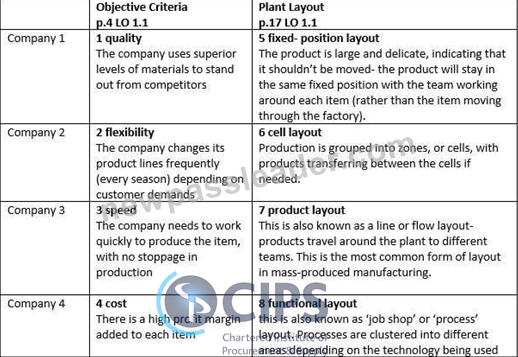
NEW QUESTION # 69
The goal of Operations Management is to create processes which ensure the three Es: Efficiency, Effectiveness and Efficacy. What is meant be Efficacy?
- A. the process is cost-effective
- B. the process meets the intended purpose
- C. the process produces as little waste as possible
- D. the process is optimised
Answer: B
Explanation:
1 is correct, Efficacy means the process meets its intended purpose (i.e. that it produces the intended result/ effect). This is from p.3 of the study guide.
NEW QUESTION # 70
There are four dimensions of operating processes; volume, variety, variation and visibility. What is meant by variation?
- A. the amount of different uses for the item being produced
- B. the fluctuation in demand for an item
- C. the number of different customers / markets for the product
- D. the number of different products made
Answer: B
Explanation:
The correct answer is 1- fluctuation in demand for an item. E.g. demand for woolly hats has a high variation depending on the time of year. Other products such as bread have a low variation as demand is more constant. Be careful not to confuse variation with variety. Variety is the number of different products made. This is from p.48-49
NEW QUESTION # 71
Which of the following are considered 'transformed resources' and an input into the Operations Process (input- processoutput)?
Select THREE
- A. customers
- B. employees
- C. money
- D. information
- E. raw materials
Answer: A,D,E
Explanation:
Customers, Raw Materials and Information are inputs. This is from p.44-45. Raw materials is the obvious one- it's the input in manufacturing and is transformed into a finished good. Information is an input in the service industry- for example a lawyer or an accountant requires information in order to prepare their case. Customers is the other correct answer and is an input in things like hairdressing (you can't cut hair without a customer's head!). Employees are considered transforming inputs not transformed resources (p.45). Money is also not an input as it isn't converted into an output.
NEW QUESTION # 72
Below are details of five companies who operate a Total Quality Management System (TQM). For each company, select the system used and identify which area of the Balanced Scorecard this relates to.
Company 1: The focus of this company is to gather real-time data to assess the quality of products created during the manufacturing process. There are tight budgets and reworking any defects will affect the bottom line.
Company 2: This company is concerned about how their products are received. They have recently completed market research focused on their client's feelings. The objective is now to improve the product's look and performance to meet these expectations.
Company 3: The focus of this company is defining the customer requirements and translating this into a high-quality specification and effective operational process.
Company 4: Within this company there is a group of 6 employees who meet regularly with the objective of reducing issues that arise in the manufacturing of products.
Complete the table below by listing the TQM System used and the relevant Balanced Scorecard criteria for each company. Each response should only be used once: Quality Circle, Statistical Process Control, Kansei Engineering, Quality Function Deployment, Finance Criteria, Business Process Criteria, Learning and Growth Criteria, Customer Criteria.
Which of the following will you put into box 5?
- A. business process criteria
- B. finance criteria
- C. customer criteria
- D. learning and growth criteria
Answer: B
Explanation:
The correct answers are as follows: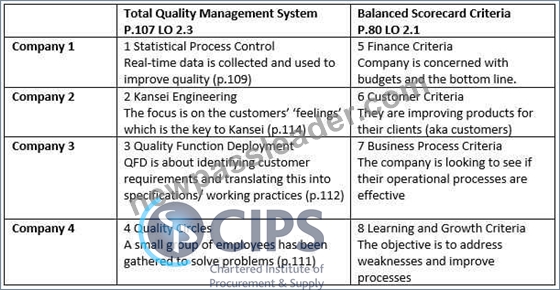
NEW QUESTION # 73
Total Productive Maintenance and Just in Time are examples of Total Quality Management (TQM). Is this correct?
- A. no- TQM includes Kansai engineering
- B. no- TQM includes quality circles and quality function deployment
- C. yes- other examples include statistical process control
- D. yes- other examples include business process re-engineering
Answer: C
Explanation:
The correct answer is 2. Firstly the statement is true TPM and JIT are examples of TQM- so discount options 3 and 4. Between 1 and 2 - 1 is incorrect as BPR is not a form of TQM but statistical process control is. This is from p.107. There are 6 types of TQM- do learn these all for the exam- it's known to come up frequently in the exam.
NEW QUESTION # 74
Blue Slipper Ltd is a multi-national organisation that produces a variety of cosmetic products. A team has been put together to create a strategy for the Marketing Department in order to increase sales and thus profitability. What level of strategy is being created?
- A. corporate level strategy
- B. functional level strategy
- C. business level strategy
- D. operational level strategy
Answer: B
Explanation:
The correct answer is functional level strategy as Marketing is a function within the business. P.32 discusses the three levels of strategy: corporate (whole organisation), business level (divided by business unit such as lipsticks, mascara etc) and function (divided by department such as marketing, operations and HR). The last option is made up.
NEW QUESTION # 75
Which of the following is a computer-based programme which determines the amounts of inputs required into a process?
- A. Work Scheduling
- B. MRP
- C. Kaizen
- D. Just in Time
Answer: B
Explanation:
This is MRP. You will likely remember this from Level 4- it comes up again here but there's nothing new that you won't have seen before. P.55
NEW QUESTION # 76
Spotted Elephant Ltd is a confectionary manufacturer whose operations department is headed by Brian. Brian is looking into Total Quality Management and ways of implementing this in the factory. He is considering the introduction of Total Productive Maintenance. What would this involve?
- A. servicing the machinery more frequently
- B. using a pull inventory system
- C. business process re-engineering
- D. introducing quality assurance processes for the confectionary items produced
Answer: A
Explanation:
2 is the correct answer. The Total Productive Maintenance approach is about ensuring machinery is always at fulloperating power. In order to do this, the machinery will need to be serviced more frequently. See p.109
NEW QUESTION # 77
Under what circumstances would an 'intermittent operations' process be the most suitable?
- A. an organisation with low numbers of manufacturing staff
- B. many different items are produced in low quantities
- C. where quality assurance must be carried out regularly
- D. in high value, high volume production
Answer: B
Explanation:
1 is the correct answer. Intermittent operations is when you have different products that require different product arrangements. For example when you produce several items in small batches and need to change the configuration of the machines regularly. A factory that makes boxes of chocolates will use intermittent operations as they'll produce 12 different types of chocolate to go into the boxes- they'll need to stop operations after each type is made, to then set up to make the next type. This is the opposite of continuous production, where you make one product continuously (e.g. tins of tomatoes). This is from p.13. Option 2 is incorrect as quality assurance wouldn't stop production. Option 3 is incorrect as you can have a few staff doing continuous operations. Option 4 is incorrect as a high volume would indicate this is continuous production rather than intermittent. See p.13.
NEW QUESTION # 78
Performance Benchmarking is a form of what type of benchmarking?
- A. non-competitive
- B. competitive
- C. internal
- D. external
Answer: C
Explanation:
Performance Benchmarking is an internal form of benchmarking where you compare the performance of 2 different departments against each other. This is from p.82.
NEW QUESTION # 79
An Operations Manager is responsible for making many decisions. Which of the following would be a strategic decision made by an Operations Manager?
- A. creating quality standards
- B. deciding which inventory to carry
- C. deciding how to allocate key raw materials among the functional areas
- D. scheduling the production of manufactured goods
Answer: C
Explanation:
4 is the only strategic decision listed here. The other options are 'operations decisions' rather than 'strategic'. Strategic decisions influence the direction the company is going in and may have an effect on the long-term strategy of the company. Operational decisions are about ensuring everything runs smoothly and the Five Rights are achieved. This is from p.4-6 of the study guide.
NEW QUESTION # 80
Which of the following situations would use a fixed-position layout?
- A. ship construction
- B. vehicle assembly
- C. supermarket
- D. buffet style restaurant
Answer: A
Explanation:
Ship construction would used a fixed-position layout. This is when you're making something that is too big/ heavy to pass through a traditional factory / conveyor belt set up. So rather than the item passing to different teams/ departments, each team / department comes to the item when it is their time to work on it. In the other examples the item (vehicle, food in the supermarket or buffet) the products get moved around- the ship is the only item that remains where it is. This question is based on the 4 types of Plant Layout on p.17. This could form part of a drag and drop question too.
NEW QUESTION # 81
Logan has recently been appointed to the position of Operations Manager within in IT firm. The CEO has charged Logan with improving the performance of the department, in particular, in ensuring that promises made to customers are kept. Logan is therefore prioritising KPIs for the team including the delivering of services on-time and customer retention.
Which of the 5 Performance Objectives of Operations Management is Logan focusing on?
- A. speed
- B. quality
- C. flexibility
- D. dependability
Answer: D
Explanation:
This is dependability because it relates to keeping promises to customers. This is from p.37.
NEW QUESTION # 82
Continuous Operations is a manufacturing methodology which is driven by forecasted customer numbers and has a low level of work-in-progress inventory. Is this true?
- A. yes- in continuous operations there is a high level of standardisation
- B. no- in continuous operations actual customer numbers are used
- C. yes- in continuous operations there is a low level of automation
- D. no- in continuous operations there is a high level of work-in-progress inventory
Answer: A
Explanation:
Firstly, look to see if the statement is true or false. It is true (this is taken from the table comparing continuous operations to intermittent operations on p.15). Therefore you can automatically discount options 3 and 4. Between 1 and 2, option 1 is incorrect as there is a high level of automation in continuous operations.
NEW QUESTION # 83
The DMAIC Methodology includes five phases, what are these?
- A. define, manufacture, apply, increase, conclude
- B. design, manufacture, analyse, implement, control
- C. design, measure, apply, improve, consult
- D. define, measure, analyse, improve, control
Answer: D
Explanation:
1 is the correct answer. DMAIC stands for define, measure, analyse, improve, control. It's a common methodology applied in Six-Sigma. P.137
NEW QUESTION # 84
A lorry used for transporting goods between warehouses has a light that flashes up on the dashboard when engine oil needs to be replaced soon. This is an example of what form of maintenance?
- A. reactive
- B. condition-based maintenance
- C. preventative
- D. run to breakdown
Answer: B
Explanation:
This is an example of condition-based maintenance. This is when, prior to failure, the user is alerted to a potential problem and given time to fix it before it happens. Preventative maintenance is proactively checking regularly, so in this scenario it would be the driver checking the oil level manually before each journey. Reactive maintenance would be changing the oil when it needs changing (not beforehand). Run to breakdown would be driving the vehicle until it doesn't go any more then replacing the vehicle. See p.103.
NEW QUESTION # 85
Total Quality Management is built on 8 founding principles. Which of the following do these include? Select THREE.
- A. supply chain integration
- B. fact-based decision making
- C. bottom-up process design
- D. process improvement
- E. employee involvement
Answer: B,D,E
Explanation:
The other 5 principles are; customer focus, system integration, communication and continuous improvement
NEW QUESTION # 86
In order to keep processing costs down, which of the following should a company opt for in terms of operating processes?
- A. low volume, high variety
- B. low variation, high visibility
- C. high volume, low variety
- D. high variation, low visibility
Answer: C
Explanation:
2 is the correct response. This is the only response where both characteristics given keeps costs down. High volume means a lower unit cost and higher profits. Low variety keeps costs down as you don't need to produce many different products. In the other three options high variety, high variation and high visibility all lead to increased costs. P. 50
NEW QUESTION # 87
......
L5M9 Exam Practice Materials Collection: https://pass4lead.newpassleader.com/CIPS/L5M9-exam-preparation-materials.html