

Latest [Apr 26, 2026] AWS-Developer Exam with Accurate AWS Certified Developer Associate Exam (DVA-C02) PDF Questions
Take a Leap Forward in Your Career by Earning Amazon 370 Questions
The AWS-Developer exam is a challenging but rewarding certification to pursue for developers interested in building their expertise in AWS application development and management. With the growing demand for cloud-based applications, achieving this certification can help developers stay competitive in the job market and advance their careers in the field of cloud computing.
NEW QUESTION # 114
An on-premises legacy application is caching data files locally and writing shared images to local disks.
What is necessary to allow for horizontal scaling when migrating the application to AWS?
- A. Modify the application to read and write cache data on Amazon S3, and also store shared images on S3.
- B. Modify the application to have both shared images and caching data written to Amazon EBS.
- C. Modify the application to use Amazon S3 for serving shared images; cache data can then be written to local disks.
- D. Modify the application to read and write cache data on Amazon S3, while continuing to write shared images to local disks.
Answer: C
NEW QUESTION # 115
Given the source code for an AWS Lambda function in the local store.py containing a handler function called get_store and the following AWS CloudFormation template: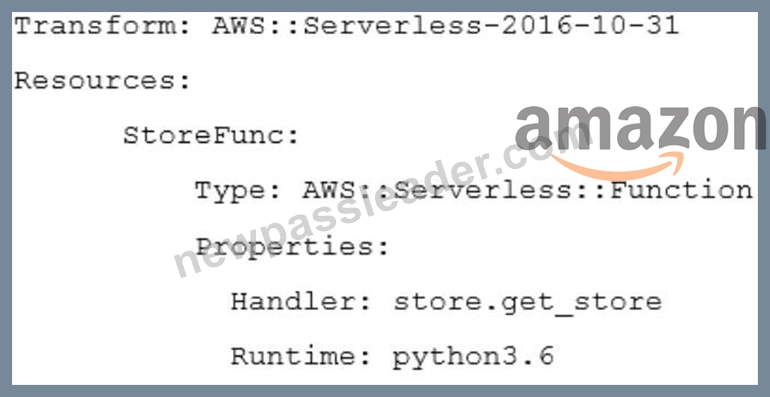
What should be done to prepare the template so that it can be deployed using the AWS CLI command aws cloudformation deploy?
- A. Use aws cloudformation compile to base64 encode and embed the source file into a modified CloudFormation template.
- B. Use aws cloudformation package to upload the source code to an Amazon S3 bucket and produce a modified CloudFormation template.
- C. Use aws lambda zip to package the source file together with the CloudFormation template and deploy the resulting zip archive.
- D. Use aws serverless create-package to embed the source file directly into the existing CloudFormation template.
Answer: B
Explanation:
Explanation
https://docs.aws.amazon.com/cli/latest/reference/cloudformation/package.html
NEW QUESTION # 116
A Development team decides to adopt a continuous integration/continuous delivery (CI/CD) process using AWS CodePipeline and AWS CodeCommit for a new application. However, management wants a person to review and approve the code before it is deployed to production.
How can the Development team add a manual approver to the CI/CD pipeline?
- A. If approved, add an approved tag when pushing changes to the CodeCommit repository.
CodePipeline will proceed to build and deploy approved commits without interruption. - B. Use AWS SES to send an email to approvers when their action is required. Develop a simple application that allows approvers to accept or reject a build. Invoke an AWS Lambda function to advance the pipeline when a build is accepted.
- C. Add an approval action to the pipeline. Configure the approval action to publish to an Amazon SNS topic when approval is required. The pipeline execution will stop and wait for an approval.
- D. Add an approval step to CodeCommit. Commits will not be saved until approved.
Answer: C
Explanation:
https://docs.aws.amazon.com/codepipeline/latest/userguide/approvals-action-add.html
NEW QUESTION # 117
Which EC2 API call would you use to retrieve a list of Amazon Machine Images (AMIs)?
- A. DescribeImages
- B. You cannot retrieve a list of AMIs as there are over 10,000 AMIs
- C. GetAMls
- D. DescribeAMls
- E. DescnbeInstances
Answer: B
NEW QUESTION # 118
A developer is using Amazon S3 as the event source that invokes a Lambda function when new objects are created in the bucket The event source mapping Information Is stored in the bucket notification configuration The developer is working with different versions of the Lambda function, and has a constant need to update notification configuration so that Amazon S3 invokes the correct version What is the MOST efficient and effective way to achieve mapping Between the S3 event and Lambda?
- A. Use a Lambda alias
- B. Use a different Lambda trigger
- C. Use Lambda environment variables
- D. Use Lambda tags.
Answer: B
NEW QUESTION # 119
When writing a Lambda function, what is the benefit of instantiating AWS clients outside the scope of the handler?
- A. Better error handling
- B. Creating a new instance per invocation
- C. Taking advantage of connection re-use
- D. Legibility and stylistic convention
Answer: C
Explanation:
Explanation/Reference: https://www.jeremydaly.com/reuse-database-connections-aws-lambda/
NEW QUESTION # 120
A company stores all personally identifiable information (Pll) in an Amazon DynamoDB table named Pll in Account A. An application running on Amazon EC2 instances in Account B requires access to the Pll table.
An administrator in Account A created an IAM role named AccessPII with privileges to access the Pll table and made Account B a trusted entity.
Which combination of additional steps should developers take to access the table1? (Select TWO )
- A. Include the AssumeRole API in the application code logic to obtain credentials to access the Pll table.
- B. Ask an administrator in Account B to allow the EC2 IAM role permission to assume the AccessPII role with predefined service control policies
- C. Ask an administrator in Account B to allow the EC2 IAM role permission to assume the AccessPII role
- D. Include the Gets ess ionToken API in the application code logic to obtain credentials to access the Pll table
- E. Ask an administrator in Account A to allow the EC2 IAM role permission to assume the AccessPII role with predefined service control policies
Answer: A,C
NEW QUESTION # 121
A Developer is migrating an on-premises application to AWS. The application currently takes user uploads and saves them to a local directory on the server. All uploads must be saved and made immediately available to all instances in an Auto Scaling group.
Which approach will meet these requirements?
- A. Use Amazon EBS and configure the application AMI to use a snapshot of the same EBS instance on boot.
- B. Use Amazon S3 and rearchitect the application so all uploads are placed in S3.
- C. Use Amazon EBS and file synchronization software to achieve eventual consistency among the Auto Scaling group.
- D. Use instance storage and share it between instances launched from the same Amazon Machine Image (AMI).
Answer: D
NEW QUESTION # 122
A company created an application to consume and process data. The application uses Amazon SQS and AWS Lambda functions. The application is currently working as expected, but it occasionally receives several messages that it cannot process properly. The company needs to clear these messages to prevent the queue from becoming blocked. A developer must implement a solution that makes queue processing always operational. The solution must give the company the ability to defer the messages with errors and save these messages for further analysis. What is the MOST operationally efficient solution that meets these requirements?
- A. Configure an Amazon CloudWatch alarm for Lambda function errors. Publish messages to an Amazon SNS topic to notify administrator users.
- B. Create a new SQS queue. Set the new queue as a dead-letter queue for the application queue. Configure the Maximum Receives setting.
- C. Change the SQS queue to a FIFO queue. Configure the message retention period to 0 seconds.
- D. Configure Amazon CloudWatch Logs to save the error messages to a separate log stream.
Answer: B
Explanation:
Using a dead-letter queue (DLQ) with Amazon SQS is the most operationally efficient solution for handling unprocessable messages.
* Amazon SQS Dead-Letter Queue:
* A DLQ is used to capture messages that fail processing after a specified number of attempts.
* Allows the application to continue processing other messages without being blocked.
* Messages in the DLQ can be analyzed later for debugging and resolution.
* Why DLQ is the Best Option:
* Operational Efficiency: Automatically defers messages with errors, ensuring the queue is not blocked.
* Analysis Ready: Messages in the DLQ can be inspected to identify recurring issues.
* Scalable: Works seamlessly with Lambda and SQS at scale.
* Why Not Other Options:
* Option A: Logs the messages but does not resolve the queue blockage issue.
* Option C: FIFO queues and 0-second retention do not provide error handling or analysis capabilities.
* Option D: Alerts administrators but does not handle or store the unprocessable messages.
Steps to Implement:
* Create a new SQS queue to serve as the DLQ.
* Attach the DLQ to the primary queue and configure the Maximum Receives setting.
:
Using Amazon SQS Dead-Letter Queues
Best Practices for Using Amazon SQS with AWS Lambda
NEW QUESTION # 123
An application stores payroll information nightly in DynamoDB for a large number of employees across
hundreds of offices. Item attributes consist of individual name, office identifier, and cumulative daily hours.
Managers run reports for ranges of names working in their office. One query is. "Return all Items in this
office for names starting with A through E". Which table configuration will result in the lowest impact on
provisioned throughput for this query?
- A. Configure the table to have a range index on the name attribute, and a hash index on the office
identifier - B. Configure a hash index on the name attribute and no range index
- C. Configure a hash index on the office Identifier attribute and no range index
- D. Configure the table to have a hash index on the name attribute, and a range index on the office
identifier
Answer: A
NEW QUESTION # 124
A website's page load times are gradually increasing as more users access the system at the same time. Analysis indicates that a user profile is being loaded from a database in all the web pages being visited by each user and this is increasing the database load and the page load latency. To address this issue the Developer decides to cache the user profile data.
Which caching strategy will address this situation MOST efficiently?
- A. Use a dedicated Amazon RDS instance for caching profile data. Use a write-through caching strategy.
- B. Create an Amazon ElastiCache cluster to cache the user profile data. Use a cache-aside caching strategy.
- C. Create an ElastiCache cluster to cache the user profile data. Use a write-through caching strategy.
- D. Create a new Amazon EC2 Instance and run a NoSQL database on it. Cache the profile data within this database using the write-through caching strategy.
Answer: B
NEW QUESTION # 125
A Developer migrated a web application to AWS. As part of the migration, the Developer implemented an automated continuous integration/continuous improvement (CI/CD) process using a blue/green deployment.
The deployment provisions new Amazon EC2 instances in an Auto Scaling group behind a new Application Load Balancer. After the migration was completed, the Developer began receiving complaints from users getting booted out of the system. The system also requires users to log in after every new deployment.
How can these issues be resolved?
- A. Use rolling updates instead of a blue/green deployment
- B. Externalize the user sessions to Amazon ElastiCache
- C. Turn on sticky sessions in the Application Load Balancer
- D. Use multicast to replicate session information
Answer: C
Explanation:
Explanation/Reference:
NEW QUESTION # 126
A Developer is creating a serverless website with content that includes HTML files, images, videos, and JavaScript (client-side scripts).
Which combination of services should the Developer use to create the website?
- A. Amazon EC2 and Amazon ElastiCache
- B. AWS Lambda and Amazon API Gateway
- C. Amazon S3 and Amazon CloudFront
- D. Amazon ECS and Redis
Answer: C
Explanation:
Explanation/Reference: https://d1.awsstatic.com/whitepapers/Building%20Static%20Websites%20on%20AWS.pdf
NEW QUESTION # 127
A company is about to migrate an application from its on-premises data center to AWS. As part of the
planning process, the following requirements involving DNS have been identified.
On-premises systems must be able to resolve the entries in an Amazon Route 53 private hosted zone.
Amazon EC2 instances running in the organization's VPC must be able to resolve the DNS names of
on-premises systems
The organization's VPC uses the CIDR block 172.16.0.0/16.
Assuming that there is no DNS namespace overlap, how can these requirements be met?
- A. Change the DHCP options set for the VPC to use both the Amazon-provided DNS server and the on-
premises DNS systems. Configure the on-premises DNS systems with a stub-zone, delegating the
name server 172.16.0.2 as authoritative for the Route 53 private hosted zone. - B. Deploy and configure a set of EC2 instances into the company VPC to act as DNS proxies. Configure
the proxies to forward queries for the on-premises domain to the on-premises DNS systems, and
forward all other queries to the Amazon-provided DNS server (172.16.0.2). Change the DHCP options
set for the VPC to use the new DNS proxies. Configure the on-premises DNS systems with a stub-
zone, delegating the proxies as authoritative for the Route 53 private hosted zone. - C. Change the DHCP options set for the VPC to use both the on-premises DNS systems. Configure the
on-premises DNS systems with a stub-zone, delegating the Route 53 private hosted zone's name
servers as authoritative for the Route 53 private hosted zone. - D. Deploy and configure a set of EC2 instances into the company VPC to act as DNS proxies. Configure
the proxies to forward queries for the on-premises domain to the on-premises DNS systems, and
forward all other queries to 172.16.0.2. Change the DHCP options set for the VPC to use the new DNS
proxies. Configure the on-premises DNS systems with a stub-zone, delegating the name server
172.16.0.2 as authoritative for the Route 53 private hosted zone.
Answer: B
NEW QUESTION # 128
You have written an application that uses the Elastic Load Balancing service to spread traffic to several
web servers Your users complain that they are sometimes forced to login again in the middle of using
your application, after they have already togged in. This is not behavior you have designed. What is a
possible solution to prevent this happening?
- A. Use ElastiCache to save session state.
- B. Use instance storage to save session state.
- C. Use Glacier to save session slate.
- D. Use instance memory to save session state.
- E. Use EBS to save session state
Answer: A
NEW QUESTION # 129
An organization has created multiple components of a single application for compartmentalization.
Currently all the components are hosted on a single EC2 instance. Due to security reasons the organization wants to implement two separate SSLs for the separate modules although it is already using VPC. How can the organization achieve this with a single instance?
- A. Create a VPC instance which will have both the ACL and the security group attached to it and have separate rules for each IP address.
- B. Create a VPC instance which will have multiple subnets attached to it and each will have a separate IP address.
- C. You have to launch two instances each in a separate subnet and allow VPC peering for a single IP.
- D. Create a VPC instance which will have multiple network interfaces with multiple elastic IP addresses.
Answer: D
Explanation:
A Virtual Private Cloud (VPC) is a virtual network dedicated to the user's AWS account. It enables the user to launch AWS resources into a virtual network that the user has defined. With VPC the user can specify multiple private IP addresses for his instances.
The number of network interfaces and private IP addresses that a user can specify for an instance depends on the instance type. With each network interface the organization can assign an EIP. This scenario helps when the user wants to host multiple websites on a single EC2 instance by using multiple SSL certificates on a single server and associating each certificate with a specific EIP address. It also helps in scenarios for operating network appliances, such as firewalls or load balancers that have multiple private IP addresses for each network interface.
Reference: http://docs.aws.amazon.com/AWSEC2/latest/UserGuide/MultipleIP.html
NEW QUESTION # 130
When you use the AWS Elastic Beanstalk console to deploy a new application you'll need to upload a source bundle and it should ___________________________.
- A. Consist of a single .war file
- B. Consist of a single .zip file or .war file
- C. Consist of a single .zip file
- D. Consist of a folder with all files
Answer: B
Explanation:
When you use the AWS Elastic Beanstalk console to deploy a new application or an application version, you'll need to upload a source bundle. Your source bundle must meet the following requirements:
Consist of a single .zip file or .war file
Not exceed 512 MB
Not include a parent folder or top-level directory (subdirectories are fine)
http://docs.aws.amazon.com/elasticbeanstalk/latest/dg/using-features.deployment.source.html
NEW QUESTION # 131
An application that is hosted on an Amazon EC2 instance needs access to files that are stored in an Amazon S3 bucket. The application lists the objects that are stored in the S3 bucket and displays a table to the user.
During testing, a developer discovers that the application does not show any objects in the list.
What is the MOST secure way to resolve this issue?
- A. Update the IAM instance profile that is attached to the EC2 instance to include the S3:ListBucket permission for the S3 bucket.
- B. Update the IAM instance profile that is attached to the EC2 instance to include the S3:* permission for the S3 bucket.
- C. Update the developer's user permissions to include the S3:ListBucket permission for the S3 bucket.
- D. Update the S3 bucket policy by including the S3:ListBucket permission and by setting the Principal element to specify the account number of the EC2 instance.
Answer: A
Explanation:
IAM instance profiles are containers for IAM roles that can be associated with EC2 instances. An IAM role is a set of permissions that grant access to AWS resources. An IAM role can be used to allow an EC2 instance to access an S3 bucket by including the appropriate permissions in the role's policy. The S3:ListBucket permission allows listing the objects in an S3 bucket. By updating the IAM instance profile with this permission, the application on the EC2 instance can retrieve the objects from the S3 bucket and display them to the user. Reference: Using an IAM role to grant permissions to applications running on Amazon EC2 instances
NEW QUESTION # 132
An Amazon Simple Queue Service (Amazon SQS) queue serves as an event source for an AWS Lambda function In the SQS queue, each item corresponds to a video file that the Lambda function must convert to a smaller resolution The Lambda function is timing out on longer video files, but the Lambda function's timeout is already configured to its maximum value What should a developer do to avoid the timeouts without additional code changes'?
- A. Increase the memory configuration of the Lambda function
- B. Use multi-threading for the conversion.
- C. Increase the instance size of the host that runs the Lambda function.
- D. Increase the visibility timeout on the SQS queue
Answer: D
Explanation:
* Visibility Timeout: When an SQS message is processed by a consumer (here, the Lambda function), it's temporarily hidden from other consumers. Visibility timeout controls this duration.
* How It Helps:
* Increase the visibility timeout beyond the maximum processing time your Lambda might typically take for long videos.
* This prevents the message from reappearing in the queue while Lambda is still working, avoiding premature timeouts.
References:
SQS Visibility Timeout: https://docs.aws.amazon.com/AWSSimpleQueueService/latest/SQSDeveloperGuide
/sqs-visibility-timeout.html
NEW QUESTION # 133
You are designing a photo sharing mobile app the application will store all pictures in a single Amazon S3 bucket. Users will upload pictures from their mobile device directly to Amazon S3 and will be able to view and download their own pictures directly from Amazon S3. You want to configure security to handle potentially millions of users in the most secure manner possible. What should your server-side application do when a new user registers on the photo-sharing mobile application?
- A. Record the user's Information in Amazon RDS and create a role in IAM with appropriate permissions.
When the user uses their mobile app create temporary credentials using the AWS Security Token Service 'AssumeRole' function. Store these credentials in the mobile app's memory and use them to access Amazon S3. Generate new credentials the next time the user runs the mobile app. - B. Create a set of long-term credentials using AWS Security Token Service with appropriate permissions Store these credentials in the mobile app and use them to access Amazon S3.
- C. Create IAM user. Assign appropriate permissions to the IAM user Generate an access key and secret key for the IAM user, store them in the mobile app and use these credentials to access Amazon S3.
- D. Create an IAM user. Update the bucket policy with appropriate permissions for the IAM user Generate an access Key and secret Key for the IAM user, store them In the mobile app and use these credentials to access Amazon S3
- E. Record the user's Information in Amazon DynamoDB. When the user uses their mobile app create temporary credentials using AWS Security Token Service with appropriate permissions. Store these credentials in the mobile app's memory and use them to access Amazon S3 Generate new credentials the next time the user runs the mobile app.
Answer: A
NEW QUESTION # 134
A developer uses Amazon S3 buckets for static website hosting. The developer creates one S3 bucket for the code and another S3 bucket for the assets, such as image and video files. Access is denied when a user attempts to access the assets bucket from the code bucket, with the website application showing a 403 error How should the developer solve this issue?
- A. Create an IAM role and apply it to the assets bucket for the code bucket to be granted access
- B. Edit the cross-origin resource sharing (CORS) configuration of the assets bucket to allow any origin to access the assets
- C. Edit the bucket policy of the assets bucket to open access to all principals
- D. Change the code bucket to use AWS Lambda functions instead of static website hosting.
Answer: B
NEW QUESTION # 135
......
The AWS-Developer certification is highly regarded in the industry, and it is recognized as a valuable credential for developers who work with AWS. Obtaining this certification demonstrates to employers that a developer has the skills and knowledge required to develop and deploy applications on the AWS platform. AWS Certified Developer Associate Exam (DVA-C02) certification can also lead to new job opportunities and higher salaries. Overall, the AWS-Developer certification is a valuable asset for any developer looking to advance their career in the cloud computing industry.
Amazon AWS-Developer (AWS Certified Developer - Associate) Exam is a certification meant for professionals who have a good understanding of AWS services and the ability to develop and maintain AWS applications. AWS-Developer exam measures the candidate's ability to develop and deploy cloud-based applications using AWS services. AWS Certified Developer Associate Exam (DVA-C02) certification is ideal for developers who are looking to enhance their skills in AWS development and want to stand out in a crowded job market.
Authentic Best resources for AWS-Developer Online Practice Exam: https://pass4lead.newpassleader.com/Amazon/AWS-Developer-exam-preparation-materials.html