

[Jan 22, 2026] CTAL_TM_001 PDF Dumps is essential on your CTAL_TM_001 Exam Questions Certain Success!
CTAL_TM_001 PDF Questions - Perfect Prospect To Go With CTAL_TM_001 Practice Exam
CTAL-TM Certified Professional Salary
- United States: $73,763
- Europe:€66508
- England: £56673
- India:₹524039
NEW QUESTION # 40
You are the Test Manager on a new project. The schedule is aggressive and will require the team to work at peak efficiency. The requirements are not well defined yet, but it is clear that the project will be using new technologies. To help the developers meet the development schedule, an offshore group will be added to the development team.
At this time there is not enough budget to add more testing resources. The project stakeholders are very concerned about the quality of delivered product and will be watching the project closely, particularly during the testing cycles. The exit criteria from the system test level require no open high priority/severity defects, 100% pass rate for all test cases covering risks that are classified as
"high" or "very high", 90% pass rate for all "medium" risks and 50% pass rate for all "low" and "very low" risks.
Given this information, which lifecycle model should you recommend? [3]
- A. Iterative/incremental
- B. Spiral
- C. V-model
- D. Waterfall
Answer: A
Explanation:
An iterative/incremental lifecycle model is a type of software development lifecycle that divides the project into smaller iterations or increments, each delivering a part of the functionality and undergoing its own planning, analysis, design, implementation, and testing phases1. This model is suitable for projects that have aggressive schedules, unclear requirements, new technologies, distributed teams, and high quality expectations, as it allows for early feedback, risk reduction, parallel development, frequent delivery, and continuous improvement2. Therefore, option B is the correct answer. Option A is incorrect because a spiral model is a type of iterative/incremental model that adds risk analysis and prototyping activities to each iteration3. While this model can also handle unclear requirements, new technologies, and high quality expectations, it may not be the best choice for projects that have aggressive schedules and distributed teams, as it requires more time and communication for risk assessment and prototyping4. Option C is incorrect because a V-model is a type of sequential model that maps each development phase to a corresponding testing phase in a V-shaped diagram5. This model is suitable for projects that have clear and stable requirements, well-known technologies, co-located teams, and moderate quality expectations, as it allows for early verification, traceability, and defect prevention. However, this model may not be the best choice for projects that have aggressive schedules, unclear requirements, new technologies, distributed teams, and high quality expectations, as it does not allow for early feedback, risk reduction, parallel development, frequent delivery, and continuous improvement. Option D is incorrect because a waterfall model is a type of sequential model that follows a linear sequence of phases from requirements to deployment. This model is suitable for projects that have simple and fixed requirements, well-known technologies, co-located teams, and low quality expectations, as it allows for easy planning, management, and documentation. However, this model may not be the best choice for projects that have aggressive schedules, unclear requirements, new technologies, distributed teams, and high quality expectations, as it does not allow for early feedback, risk reduction, parallel development, frequent delivery, and continuous improvement. Reference: 1: ISTQB Glossary, Iterative/incremental lifecycle model 2: ISTQB Advanced Level Test Manager Syllabus, Section 1.2.1 3: ISTQB Glossary, Spiral model 4: ISTQB Advanced Level Test Manager Syllabus, Section 1.2.1 5: ISTQB Glossary, V-model : ISTQB Advanced Level Test Manager Syllabus, Section 1.2.1 : ISTQB Advanced Level Test Manager Syllabus, Section 1.2.1 : ISTQB Glossary, Waterfall model : ISTQB Advanced Level Test Manager Syllabus, Section 1.2.1 : ISTQB Advanced Level Test Manager Syllabus, Section 1.2.1
NEW QUESTION # 41
Select THREE issues from the options provided that should at least be raised. 1 credit
- A. How will the change process be managed?
- B. Is customized training available?
- C. What are the problems we are trying to address?
- D. How will the implementation be organized?
- E. Do we have a set of tool requirements to validate the tool against?
- F. Which project will be selected to perform the tool pilot?
- G. Has there been sufficient comparison of tools?
Answer: C,E,G
Explanation:
Explanation/Reference:
Explanation:
NEW QUESTION # 42
You plan to use a heavyweight approach to risk-based testing on a safety-critical system and have the following information available for each documented product risk:
* The estimated cost of testing the risk
* How likely a failure would arise for the risk item
* How much the failure would cost, in terms of lossWhich technique would be MOST suitable?
- A. Fault tree analysis
- B. Failure mode and effect analysis
- C. Systematic software testing
- D. Cost of exposure
Answer: D
Explanation:
TheCost of Exposuretechnique is most suitable when you have data on thecost of testing, thelikelihood of failure, and thecost of failure. Cost of Exposure = Likelihood × Impact, which is directly applicable here:
"Risk involves the possibility of an event in the future which has negative consequences. The level of risk is determined by the likelihood of the event and the impact (the harm) from that event".
This technique helps prioritize which risks justify more testing based on potential financial impact.
NEW QUESTION # 43
In addition to risk, identify TWO other components of a testing strategy. 1 credit
- A. The test schedule
- B. Test performance indicators
- C. The entry and exit criteria for each test phase
- D. The test design techniques to be used
- E. Test training needs for the project resources
Answer: C,D
Explanation:
Explanation/Reference:
Explanation:
NEW QUESTION # 44
SoftTech provides a core banking product to retail banks to enable their customers to process payments via the Internet and telephone banking and. as SoftTech's Test Manager, you are responsible for system testing and system integration testing of all SoftTech's products.
Your current project is to integrate SoftTech's core banking product with an existing bank's systems, which are maintained by experienced developers but poorly documented.
A specification for the 10 interfaces to the bank's existing systems has been produced by SoftTech's development team. There is an estimating matrix for system integration testing that allows 2 man days per interface for preparation, plus 2 man days per interface for test execution. The exit criteria for the completion of system integration testing has been agreed as:
1. No open Severity 1 defects
2 No more than 10 open severity 2 and/or 3 defects
3. All interfaces tested
4. Cost estimate must not be exceeded
System integration test execution is scheduled to last 5 weeks, with week 5 reserved for regression and bug fixing only.
At the end of week 3 the following test report has been produced (figures on a week by week basis, not cumulative):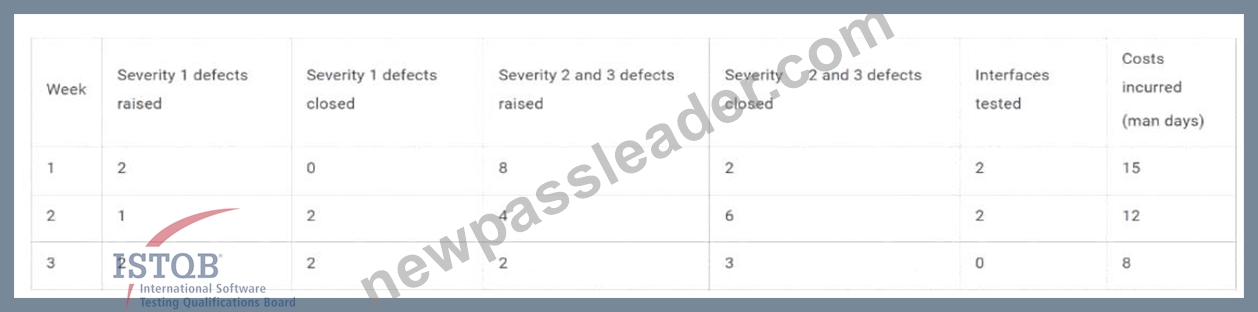
(b). Open severity 2 and 3 defects
(c). Interface testing progress
(d). Development resource for debugging
(e). Available budget
SELECT ONE OPTION
- A. d and e.
- B. c and d.
- C. b and c.
- D. c and e
Answer: B
NEW QUESTION # 45
The introduction of reviews and inspections has often failed as a process improvement action. Identify the THREE most important measures that should be taken to reduce the risk that this test process improvement will fail. 2 Credits (for 2 out of 3 correct 1 credit)
- A. Training of those involved
- B. Alignment with software process improvement
- C. The availability of stands and processes
- D. Usage of a more traditional software development lifecycle
- E. Process ownership and experienced moderators who drive the inspection process.
- F. Using a reference model, e.g. TMMi
- G. Management support
Answer: A,E,G
NEW QUESTION # 46
Which of the following team roles would be most appropriate to enhance the team and why? 2 credits
- A. A person with in-depth technical skills
- B. A person who brings new ideas to the team
- C. A person with the ability to complete tasks
- D. A quality assurance officer
Answer: B
Explanation:
Explanation/Reference:
Explanation:
NEW QUESTION # 47
In general, why is it NOT a good idea to estimate the testing effort based only on a percentage of development effort? Identify THREE valid reasons. 1 credit
- A. It builds on large set of historical data
- B. The result is almost always a too low estimate for the required test effort
- C. The percentage based technique only applies to the V life cycle model.
- D. Using the same percentage every time does not address the level of risk of the application to be tested.
- E. The maturity of the organization, e.g. the quality of the test basis, quality of development testing, configuration management, availability of test tools, also influence the effort needed for testing.
- F. In general bottom-up estimation is always better than top-down estimation.
- G. The quality of the development estimate may be poor.
Answer: D,E,G
Explanation:
Explanation/Reference:
Explanation:
NEW QUESTION # 48
Which testing metric identifies defect density? [1]
- A. Product
- B. Project
- C. People
- D. Process
Answer: A
Explanation:
Defect density is a testing metric that measures the number of defects identified in a component or system divided by the size of the component or system (expressed in standard measurement terms, e.g., lines-of-code, number of classes or function points)1. Defect density is a product metric, as it evaluates the quality or reliability of a software product2. Therefore, option B is the correct answer. Option A is incorrect because project metrics are metrics that measure the characteristics of the software project, such as cost, schedule, effort, scope, or resources3. Option C is incorrect because process metrics are metrics that measure the characteristics of the software process, such as effectiveness, efficiency, productivity, or maturity. Option D is incorrect because people metrics are metrics that measure the characteristics of the software personnel, such as skills, experience, motivation, or satisfaction. Reference: 1: Defect Density | ISTQB Glossary 2: Software Testing Metrics: What is, Types & Example 3: [Project Metrics - Software Testing Fundamentals] : [Process Metrics - Software Testing Fundamentals] : [People Metrics - Software Testing Fundamentals]
NEW QUESTION # 49
Which of the following aspects should test progress metrics be mapped to? [1]
- A. Post-implementation defect discovery rate
- B. Lines of code
- C. Defect resolution rate
- D. Exit criteria
Answer: D
Explanation:
Test progress metrics should be mapped to exit criteria to ensure that the testing process aligns with the predefined standards for completion. Exit criteria typically include conditions such as coverage of test cases, pass rates, and the resolution of major defects, which are essential for determining the end of the test phase.
Reference:
The ISTQB Advanced Level Test Manager syllabus includes the evaluation of exit criteria as part of the test monitoring and control process1. It is crucial for test managers to define and evaluate these criteria to ensure that the testing objectives have been met and that the product is ready for releas
NEW QUESTION # 50
What is the main reason why reviews are especially beneficial in the above-mentioned scenario? 2 credits
- A. They find defects early.
- B. They can be performed without exercising the code.
- C. They ensure a common understanding of the product.
- D. They enhance project communication.
Answer: B
NEW QUESTION # 51
The test improvement project will take place in an organization developing a safety-critical avionics application. Which one of the following standards do you believe would be most appropriate to take into account for compliance during your assignment? 1 credit
- A. ISO 9126
- B. DO-178B
- C. BS 7925/2
- D. IEEE 829
Answer: B
Explanation:
Explanation/Reference:
Explanation:
NEW QUESTION # 52
Which of the following is MOST likely to influence the choice of test levels for a project?
- A. The type of project
- B. Test resource constraints
- C. The product domain
- D. Availability of test data
Answer: A
Explanation:
According to ISTQB, test levels are defined based onproject and product characteristics, including whether it's a safety-critical system, customer-facing application, or infrastructure update. Hence,the type of projectis most influential.
ISTQB emphasizes adapting the lifecycle model (and hence the test levels) to thecontext of project and productcharacteristics.
NEW QUESTION # 53
You are monitoring the test results for the first week of system test execution to ensure they conform to the test plan objectives. You are guided by the list of test conditions and traceability matrix produced following test design. Test Plan objectives
* Approach - Risk-based and depth first
* Status reporting - Execution statuses must be either "Passed*, "Failed", "Blocked" or "Not Run"
* Traceability - Test execution results must be traceable back to the test conditions Test Conditions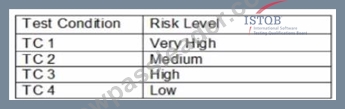
Traceability matrix
Which one of the following is a correct statement regarding the current status of test plan objectives?
SELECT ONE OPTION
- A. All the Traceability objective has been met.
- B. Only Approach and Traceability objectives have been met.
- C. All objectives have been met.
- D. None of the objectives have been met.
Answer: A
NEW QUESTION # 54
Which of the following is NOT true when following the V-Model lifecycle to organise and plan testing activities? SELECT ONE OPTION
- A. Test analysis activities run concurrently with specification of requirements and design.
- B. System test planning starts when project planning activities commence.
- C. Test execution activities run until exit criteria have been met.
- D. Reporting of all test results occurs when testing is complete for the whole project.
Answer: A
NEW QUESTION # 55
What would be a test approach regarding the test design techniques to be applied that would fit an item with the highest risk? 2 credits
- A. Component testing: decision testing; System testing: exploratory testing
- B. Component testing: decision testing; System testing: decision table testing
- C. Component testing: statement testing; System testing: decision table partitioning
- D. Component testing: statement testing; System testing: equivalence partitioning
Answer: B
Explanation:
Topic 6, Scenario 6, V4 "Independent Test Team"
You have for a while been trying to hire a second test automation specialist for your test team However, you did not have any luck in finding a suitable candidate. So now, you have been asked by IT management of XYZ to forward a proposal with alternative solutions for building an automated regression test suite at system test level over a period of 2 years including needed training and eventual handover to the test team.
NEW QUESTION # 56
You are about to release a test progress report to a senior manager, who is not a test specialist.
Which of the following topics should NOT be included in the test progress report? 1 credit
- A. Detailed overview of the risk-based test approach being used to ensure the exit criteria to be achieved
- B. Recommendations for taking controlling actions
- C. Product risks which have been mitigated and those which are outstanding.
- D. Status compared against the started exit criteria
Answer: A
Explanation:
Explanation/Reference:
Explanation:
NEW QUESTION # 57
Which of the following is likely to occur if reviewers do not have an adequate level of technical knowledge?
[1]
- A. The review is likely to be less efficient.
- B. The review will be shorter because any technical aspect can be skipped.
- C. There will be no impact as long as they have sufficient process knowledge.
- D. There will be no impact as long as they have sufficient business knowledge.
Answer: A
Explanation:
If reviewers do not have an adequate level of technical knowledge, they may not be able to identify and describe anomalies in the product or project under review1. They may also not be able to provide constructive feedback or suggestions for improvement2. This can result in a less efficient review, as the review objectives may not be met, the review process may take longer, or the review outcome may be of lower quality3.
Therefore, option C is the correct answer. Option A is incorrect because having sufficient business knowledge is not enough to perform a technical review, as business knowledge does not cover the technical aspects of the product or project4. Option B is incorrect because having sufficient process knowledge is not enough to perform a technical review, as process knowledge does not cover the technical aspects of the product or project4. Option D is incorrect because skipping any technical aspect can compromise the quality and completeness of the review, and may lead to defects or risks in the product or project5. References: 1: ISTQB Glossary, Reviewer 2: ISTQB Advanced Level Test Manager Syllabus, Section 2.2.2 3: ISTQBAdvanced Level Test Manager Syllabus, Section 2.2.3 4: ISTQB Advanced Level Test Manager Syllabus, Section
2.3.1 5: ISTQB Advanced Level Test Manager Syllabus, Section 2.3.2
NEW QUESTION # 58
Which of the following is an example of testing as part of the requirements specification phase? 1 credit
- A. A business analyst eliciting requirements
- B. A requirements review meeting
- C. Performing acceptance tests against requirements
- D. A test report showing requirements coverage
Answer: B
Explanation:
Topic 3, Scenario 3 "Tool Selection and Implementation"
Your company is considering whether or not to purchase a test tool suite from a respectable vendor. Your manager has searched the internet for comparable products but none of them meets his specific requirements. A tool demonstration has been arranged for next week and your team has been invited to attend. The tool suite consists of a test management tool, test execution tool and a requirements management tool. There is the possibility of adding a performance testing tool at a later stage. You have decided to attend the demo but raise some issues beforehand regarding expectations.
NEW QUESTION # 59
You have been asked to write a testing strategy for the company. Which statement best explains how risk can be addressed within the testing strategy? 1 credit
- A. A test strategy is the result of a project risk analysis and defines the approach and resources for testing.
- B. A test strategy identifies the specific product for a project risk and defines the approach for the test project.
- C. A test strategy is derived from the test policy and describes the way risk assessments are performed in projects.
- D. A test strategy should address identified generic product risks and present a process for mitigating those risks in line with the testing policy.
Answer: D
NEW QUESTION # 60
You are managing the testing for a bank card project. The testing was scheduled to take 10 weeks but by the time the software was developed only six weeks were available for testing Knowing there were a lot of risks with the software your team started testing activities early by overseeing code reviews, defining acceptance criteria by working with the users and by doing all lest creation prior to the code arriving You are now three days away from the go-live date Your testing has mitigated all the high and medium risk items leaving only the low-risk elements unmitigated by testing You estimate it will take two weeks to manually test the low-risk elements At this point what should you do?
- A. Select one of the low-risk elements and perform depth testing to assess the residual risk
- B. Automate the testing of the untested elements to ensure they are covered
- C. Transfer the risk of the untested low-risk items to the help desk
- D. Block the go-live and start testing the low-risk elements immediately
Answer: A
Explanation:
Context Analysis:
With limited time, testing all low-risk elements is not feasible. Depth testing on a representative low-risk element helps assess potential residual risk efficiently.
Evaluation of Options:
A . Automate the testing of the untested elements to ensure they are covered:
Incorrect. There isn't enough time to implement automation.
B . Block the go-live and start testing the low-risk elements immediately:
Incorrect. Blocking the release may not be acceptable if high and medium risks are already mitigated.
C . Transfer the risk of the untested low-risk items to the help desk:
Incorrect. While a potential fallback, it doesn't address residual risk proactively.
D . Select one of the low-risk elements and perform depth testing to assess the residual risk:
Correct. This provides quick insights into potential risks and helps make an informed go/no-go decision.
Syllabus Alignment:
ISTQB emphasizes prioritizing risk mitigation through targeted testing (TM-1.3.4).
Reference:
ISTQB Advanced Level Test Management Syllabus (TM-1.3.4)
NEW QUESTION # 61
Which test process improvement model consists of five maturity levels?
- A. TMMi
- B. GQM
- C. TPI NEXT
- D. CMMi
Answer: A
Explanation:
Test Process Improvement Models:
TMMi (Test Maturity Model Integration) has five maturity levels: Initial, Managed, Defined, Measured, and Optimization.
Other models, like TPI NEXT, focus on key areas but do not use a maturity-level framework.
CMMi (Capability Maturity Model Integration) applies broadly to process improvement but is not specific to testing.
GQM (Goal-Question-Metric) is a measurement approach, not a maturity model.
Evaluation of Options:
A (TMMi) is correct as it directly incorporates a five-level maturity framework for test process improvement.
Other options are not aligned with the question context.
Reference and Syllabus Alignment:
TMMi is referenced in the ISTQB syllabus under "Improving the Test Process" (TM-1.5.1) as a standard for maturity models.
NEW QUESTION # 62
Which combination matches the four cost of quality categories with a CORRECT example of its category?
- A. a4, b3, c1, d2
- B. a3, b1, c2, d4
- C. a1, b2, c4, d3
Confirmation testing at the system test level
Deploying an emergency fix to production
Designing functional suitability tests
Strengthening recruitment criteria for technical architects - D. a2, b4, c3, d1
Answer: A
Explanation:
The Cost of Quality (CoQ) categories and examples:
* Prevention:a4# Strengthening recruitment criteria prevents defects by improving staff quality
* Appraisal:b3# Designing suitability tests is about verifying quality
* Internal Failure:c1# Confirmation testing after detecting a fault internally
* External Failure:d2# Emergency fix deployment is a result of failures in production This matches:A. a4, b3, c1, d2 Reference:CoQ definitions and examples per ISTQB Advanced Test Manager syllabus.
NEW QUESTION # 63
......
Topics of CTAL-TM Exam
Candidates must know the exam topics before they start of preparation. Because it will really help them in hitting the core. Our CTAL-TM exam dumps will include the following topics:
1. Testing Process
- Test closure activities
- Test planning, monitoring and control.
- Test implementation and execution.
- Evaluating exit criteria and reporting.
- test analysis and design
2. Test Management
- Test estimation and test metrics.
- Risk based testing.
- Distributed outsourced and insourced testing.
- Managing the application to industry standards.
3. Reviews
- Managing formal reviews.
- Metrics for reviews.
- Managing reviews.
- Management reviews and audits.
4. Defect Management
- Accessing process capability with defect report.
- Defect lifecycle.
- Defect report information.
5. Improving the testing process
- Improving the testing process with CMMi, TPI, CTP, STEP.
- Test improvement process.
6. Test tool and automation
- Tool lifecycle
- Tool metrics
- Tool selection
7. People skills
- Communication.
- Test team and dynamics.
- Individual skills.
- Fitting testing within an organization.
- Motivation.
CTAL_TM_001 Exam with Accurate ISTQB Certified Tester Advanced Level - Test Manager PDF Questions: https://pass4lead.newpassleader.com/ISTQB/CTAL_TM_001-exam-preparation-materials.html