

[Aug-2026] The Cisco 200-201 Exam Test For Brief Preparation
Revolutionary Guide To Exam Cisco Dumps
Cisco 200-201 exam is designed for individuals who have a basic understanding of networking and security concepts. Candidates who want to take the exam must have at least one year of experience in the cybersecurity field. 200-201 exam is ideal for individuals who are looking to enhance their knowledge and skills in the cybersecurity field and for those who want to pursue a career in cybersecurity operations.
NEW QUESTION # 10
Refer to the exhibit.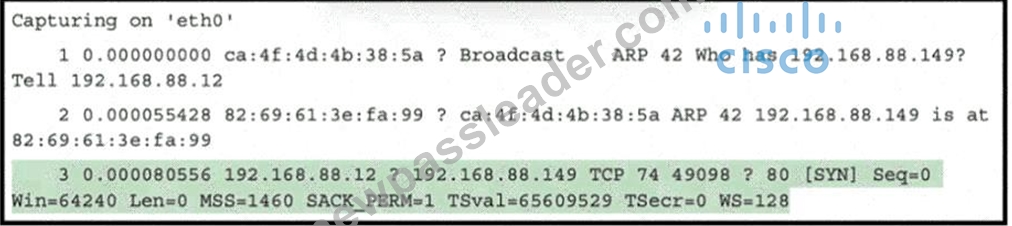
What must be interpreted from this packet capture?
- A. IP address 192.168.88.149 is communicating with 192.168.88.12 with a source port 49098 to destination port 80 using TCP protocol.
- B. IP address 192.168.88 12 is communicating with 192 168 88 149 with a source port 74 to destination port 49098 using TCP protocol
- C. IP address 192.168.88.149 is communicating with 192.168 88.12 with a source port 80 to destination port 49098 using TCP protocol.
- D. IP address 192.168.88.12 is communicating with 192 168 88 149 with a source port 49098 to destination port 80 using TCP protocol.
Answer: C
Explanation:
The packet capture shows that IP address 192.168.88.149, using source port 80 (common for HTTP traffic), initiated communication with IP address 192.168.88.12 at destination port 49098, using the TCP protocol, indicating a typical client-server interaction over the web.
= These explanations are based on general cybersecurity principles as outlined in Cisco's training and certification content, such as the Understanding Cisco Cybersecurity Operations Fundamentals (CBROPS) and other related Cisco resources.
NEW QUESTION # 11
What describes the impact of false-positive alerts compared to false-negative alerts?
- A. A false negative is alerting for an XSS attack. An engineer investigates the alert and discovers that an XSS attack happened A false positive is when an XSS attack happens and no alert is raised
- B. A false negative is a legitimate attack triggering a brute-force alert. An engineer investigates the alert and finds out someone intended to break into the system A false positive is when no alert and no attack is occurring
- C. A false positive is an event alerting for an SQL injection attack An engineer investigates the alert and discovers that an attack attempt was blocked by IPS A false negative is when the attack gets detected but succeeds and results in a breach.
- D. A false positive is an event alerting for a brute-force attack An engineer investigates the alert and discovers that a legitimate user entered the wrong credential several times A false negative is when a threat actor tries to brute-force attack a system and no alert is raised.
Answer: D
Explanation:
False positives and false negatives are terms used to describe the accuracy of security alerts. A false positive occurs when a security system incorrectly identifies benign activity as malicious, leading to unnecessary investigation and potential disruption of legitimate activities. Conversely, a false negative happens when a security system fails to detect actual malicious activity, allowing the attackers to proceed undetected. The impact of false positives is generally wasted time and resources investigating non-issues, while the impact of false negatives can be much more severe, potentially leading to undetected breaches and significant damage.
The CBROPS curriculum covers the concepts of false positives and false negatives in the context of security monitoring and alerting systems
NEW QUESTION # 12
Refer to the exhibit.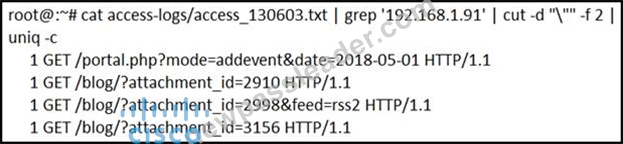
What is depicted in the exhibit?
- A. UNIX-based syslog
- B. Windows Event logs
- C. Apache logs
- D. IIS logs
Answer: A
NEW QUESTION # 13
Refer to the exhibit.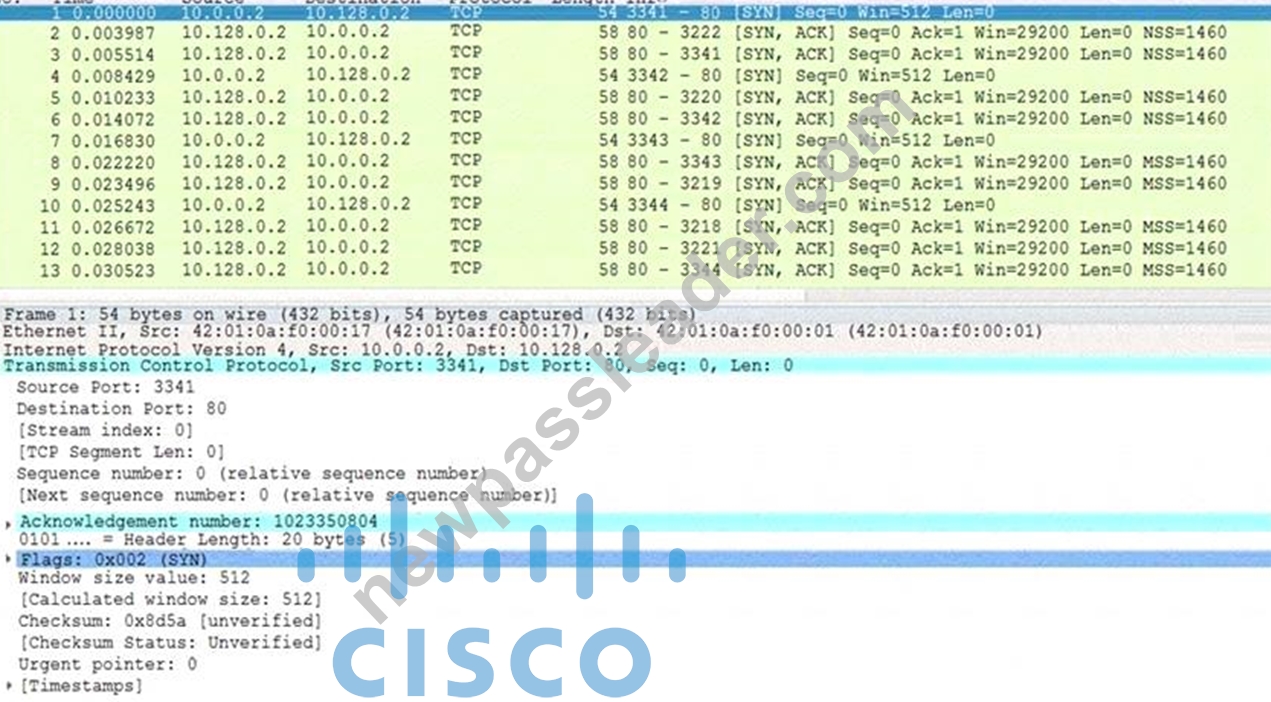
What is occurring in this network traffic?
- A. High rate of ACK packets being sent from a single source IP towards multiple destination IPs.
- B. Flood of SYN packets coming from a single source IP to a single destination IP.
- C. High rate of SYN packets being sent from a multiple source towards a single destination IP.
- D. Flood of ACK packets coming from a single source IP to multiple destination IPs.
Answer: B
NEW QUESTION # 14
Refer to the exhibit.
An engineer is reviewing a Cuckoo report of a file. What must the engineer interpret from the report?
- A. The file will insert itself into an application and execute when the application is run.
- B. The file will not execute its behavior in a sandbox environment to avoid detection.
- C. The file will appear legitimate by evading signature-based detection.
- D. The file will monitor user activity and send the information to an outside source.
Answer: B
Explanation:
The Cuckoo report indicates that the file has been identified by Yara rules as being capable of detecting a sandbox environment, which is a security mechanism for isolating and analyzing suspicious code. The presence of the "vmdetect" and "anti_dog" Yara rules suggests that the file may have mechanisms to avoid executing its malicious behavior when it detects that it is being analyzed in a sandbox. This is a common evasion technique used by malware to prevent detection and analysis by security researchers or automated systems.
NEW QUESTION # 15
Drag and drop the elements from the left into the correct order for incident handling on the right.
Answer:
Explanation:
NEW QUESTION # 16
Refer to the exhibit.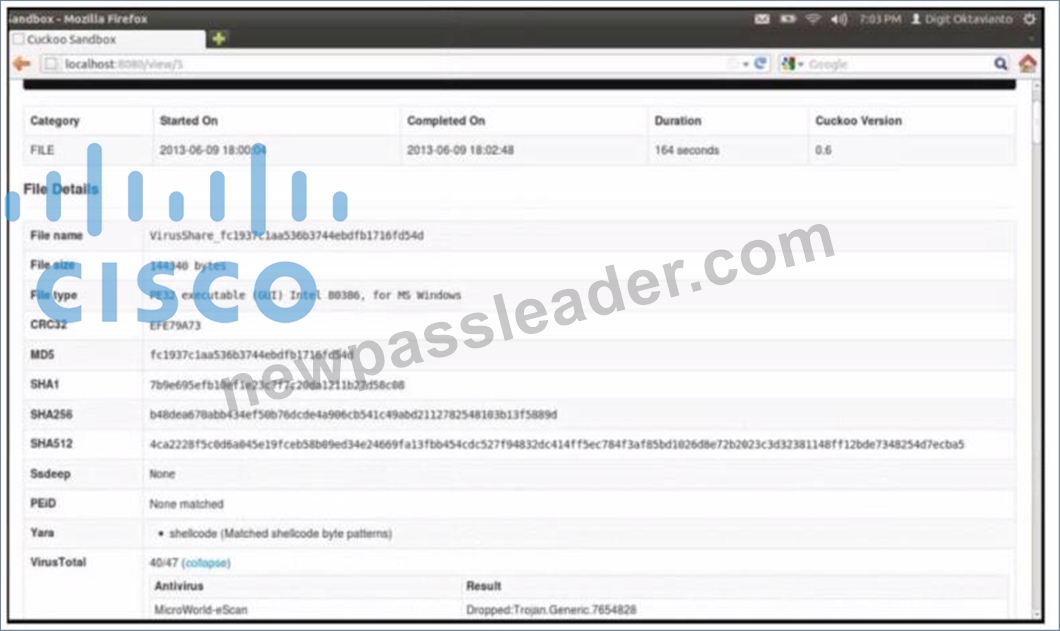
What does this Cuckoo sandbox report indicate?
- A. The file is ransomware.
- B. The file will open unsecure ports when executed.
- C. The file will open a command interpreter when executed.
- D. The file is spyware.
Answer: C
Explanation:
The Cuckoo sandbox report shows the analysis results of a file named "VirusShare_fc1937c1aa536b3744ebfb1716fd5f4d".
The file type is identified as a PE32 executable for MS Windows.
The "Yara" section indicates that the file contains shellcode, which matches specific shellcode byte patterns.
Shellcode typically indicates that the file will execute a payload, often used to open a command interpreter or execute commands directly.
Additionally, the antivirus result shows that the file was identified as containing a trojan (Trojan.Generic.7654828), which is consistent with behaviors such as opening a command interpreter for malicious purposes.
Reference:
Cuckoo Sandbox Documentation
Analysis of Shellcode Behavior
Understanding Trojan Malware Functionality
NEW QUESTION # 17
What are two differences in how tampered and untampered disk images affect a security incident? (Choose two.)
- A. Tampered images are used in the security investigation process
- B. Untampered images are used in the security investigation process
- C. The image is untampered if the stored hash and the computed hash match
- D. The image is tampered if the stored hash and the computed hash match
- E. Tampered images are used in the incident recovery process
Answer: A,C
Explanation:
Section: Host-Based Analysis
NEW QUESTION # 18
Which security principle is violated by running all processes as root or administrator?
- A. role-based access control
- B. principle of least privilege
- C. trusted computing base
- D. separation of duties
Answer: B
Explanation:
Running all processes as root or administrator violates the principle of least privilege, which states that users and processes should be granted only the minimum permissions necessary to perform their specific role or function within an organization. Running all processes as root or administrator gives them full access and control over the system, which increases the risk of unauthorized actions, malicious attacks, and accidental errors. It also makes it easier for attackers to escalate their privileges and compromise the system. References:
Understanding Cisco Cybersecurity Operations Fundamentals (CBROPS) v1.0, Module 1: Security Concepts, Lesson 1.2: Security Principles Cisco Certified CyberOps Associate Overview, Exam Topics, 1.1 Explain the CIA triad
NEW QUESTION # 19
How does an attacker observe network traffic exchanged between two users?
- A. command injection
- B. port scanning
- C. man-in-the-middle
- D. denial of service
Answer: C
Explanation:
A man-in-the-middle (MITM) attack occurs when an attacker secretly intercepts and possibly alters the communication between two parties who believe they are directly communicating with each other. In this scenario, an attacker can observe network traffic exchanged between two users by placing themselves in between their communication channel. Reference:= Cisco Blogs - New Cybersecurity and Cloud Skills to Protect Companies from Cybersecurity Attacks of the Future
NEW QUESTION # 20
What is a benefit of agent-based protection when compared to agentless protection?
- A. It manages numerous devices simultaneously
- B. It provides a centralized platform
- C. It collects and detects all traffic locally
- D. It lowers maintenance costs
Answer: B
Explanation:
Section: Security Concepts
NEW QUESTION # 21
A threat actor penetrated an organization's network. Using the 5-tuple approach, which data points should the analyst use to isolate the compromised host in a grouped set of logs?
- A. event name, log source, time, source IP, and username
- B. event name, log source, time, source IP, and host name
- C. protocol, source IP, source port, destination IP, and destination port
- D. protocol, log source, source IP, destination IP, and host name
Answer: C
Explanation:
The 5-tuple approach consists of protocol, source IP address, source port number, destination IP address, and destination port number to uniquely identify sessions between endpoints on a network. References := Cisco Cybersecurity Source Documents
NEW QUESTION # 22
Which technology prevents end-device to end-device IP traceability?
- A. load balancing
- B. NAT/PAT
- C. encryption
- D. tunneling
Answer: B
NEW QUESTION # 23
An offline audit log contains the source IP address of a session suspected to have exploited a vulnerability resulting in system compromise.
Which kind of evidence is this IP address?
- A. corroborative evidence
- B. forensic evidence
- C. best evidence
- D. indirect evidence
Answer: A
Explanation:
The source IP address from an audit log that indicates a session which may have exploited a vulnerability is considered corroborative evidence. This type of evidence supports other evidence that suggests a security breach occurred. In the context of cybersecurity, corroborative evidence can help establish that an attack was carried out and can be used in conjunction with other data points to build a case during an investigation.
References := The Understanding Cisco Cybersecurity Operations Fundamentals (CBROPS) training material discusses the types of data needed to investigate security incidents, which includes understanding the role of different types of evidence in building a security incident case1.
NEW QUESTION # 24
When an event is investigated, which type of data provides the investigate capability to determine if data exfiltration has occurred?
- A. session data
- B. full packet capture
- C. firewall logs
- D. NetFlow data
Answer: B
Explanation:
Full packet capture provides the complete recording of all the packets that are transmitted over the network.
This data is essential for in-depth analysis during an investigation, as it allows investigators to reconstruct the session, observe the content of the traffic, and determine if data exfiltration has occurred.
References: Understanding Cisco Cybersecurity Operations Fundamentals (CBROPS) study materials would typically cover the importance of full packet capture in network forensics and incident response.
NEW QUESTION # 25
......
200-201 Free Study Guide! with New Questions: https://pass4lead.newpassleader.com/Cisco/200-201-exam-preparation-materials.html