

[2026] M2 Dumps are Available for Instant Access
Valid M2 Dumps for Helping Passing M2 Exam!
NEW QUESTION # 24
Given: Fabricated of type 430 stainless steel.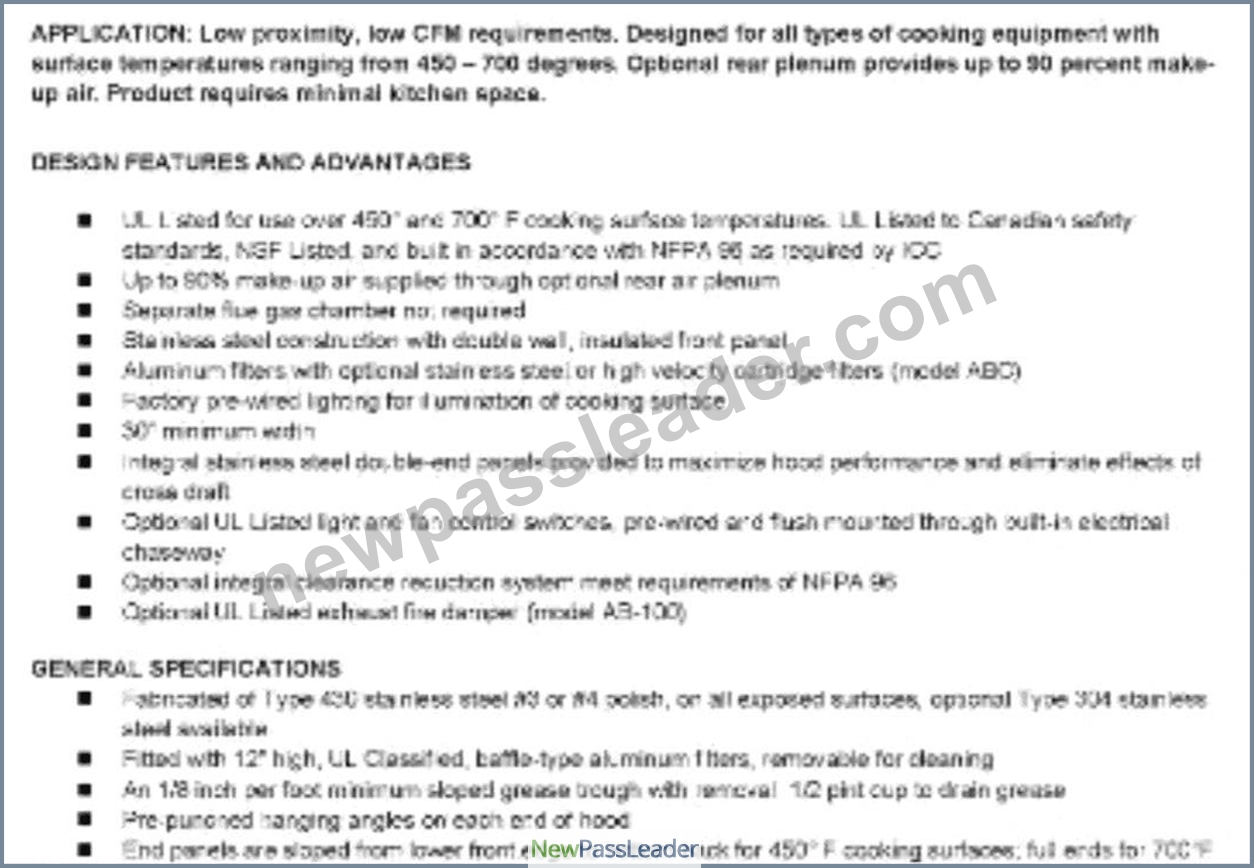
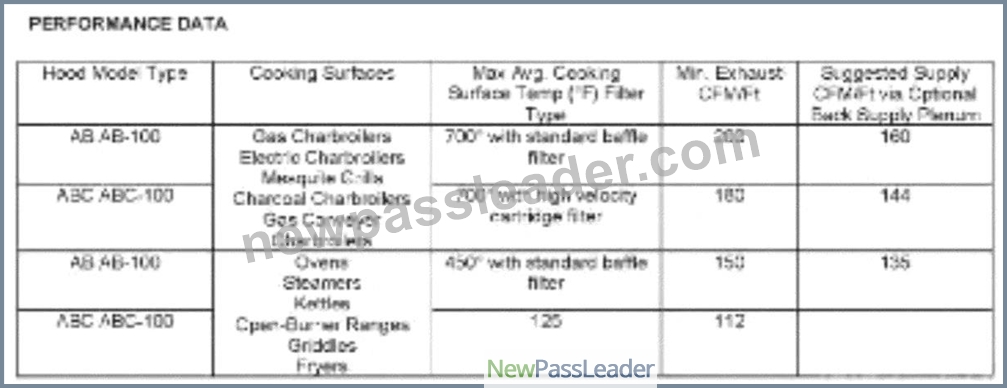
Optional type _____ stainless steel is available.
- A. 0
- B. 1
- C. 2
- D. 3
Answer: D
Explanation:
Based on the specification sheet shown in the exhibit, the hood is fabricated of Type 430 stainless steel , and the optional stainless steel listed is Type 304 . Therefore, the correct answer is C .
NEW QUESTION # 25
Floor furnaces shall not be closer than _____ inches to the ground.
- A. [option text not fully visible in the material you sent]
- B. [option text not fully visible in the material you sent]
- C. [option text not fully visible in the material you sent]
- D. 0
Answer: C
Explanation:
The ICC mechanical code requires the lowest portion of a floor furnace to have not less than 6 inches (152 mm) clearance from grade level . Therefore, the correct choice is the option corresponding to 6 inches , which is C based on your answer set.
NEW QUESTION # 26
An 8-inch Type B venting system with a listed vent cap must terminate a minimum of _____ feet above the flat roof through which it passes.
- A. 0
- B. 1
- C. 2
- D. 3
Answer: A
Explanation:
For a Type B gas vent with a listed vent cap terminating through a flat roof , the minimum required termination height is 1 foot above the roof . That makes Option A correct. This is consistent with gas vent termination tables used with listed Type B vent systems and the code framework for Type B vent terminations.
NEW QUESTION # 27
Termination of vents for appliances listed for and installed outdoors that incorporate integral venting shall:
- A. terminate not less than 5 feet vertically above the lowest connected appliance draft hood outlet or flue collar.
- B. be installed in accordance with their listings and the manufacturer's installation instructions.
- C. terminate not less than 5 feet vertically above the highest connected appliance draft hood outlet or flue collar.
- D. be installed in accordance with the design professional's plans as approved by the local building official.
Answer: B
Explanation:
For appliances listed for outdoor installation and incorporating integral venting , the IMC requires them to be installed in accordance with their listings and the manufacturer's installation instructions . That matches Option C exactly.
NEW QUESTION # 28
For gas piping installations, which of the following is an acceptable joining method for polyethylene (PE) pipe?
- A. Solvent cement
- B. Threaded coupling
- C. Compression coupling
- D. Rubber cement
Answer: C
Explanation:
This item appears to use older or simplified exam wording . Current ICC language for polyethylene plastic piping identifies heat-fusion joints, electrofusion joints, and stab-type insert fittings as the named PE joining methods, not solvent cement or threaded couplings. Among the answer choices you provided, D.
Compression coupling is the only choice that aligns most closely with a mechanical fitting/joining approach for PE systems, while rubber cement, solvent cement, and threaded coupling do not match ICC PE joining practice. Because of that, D is the best answer from the listed options, but this question should be tied to the exact code cycle or source exam bank if you want absolute cycle-specific certainty
NEW QUESTION # 29
Given: A recirculating industrial direct-fired makeup air heater has a rated input of 200,000 Btu/h .
Ventilation air is supplied by separate mechanical means.
Outside ventilation air shall be provided to supply at least _____ CFM.
- A. 0
- B. 1
- C. 2
- D. 3
Answer: D
Explanation:
The applicable provision requires direct-fired industrial air heaters to supply outside ventilation air at a rate of not less than 4 cfm per 1,000 Btu/h of rated input where ventilation air is provided by separate mechanical means. For 200,000 Btu/h , the required outside air is:
200,000 ÷ 1,000 = 200
200 × 4 = 800 cfm
So the correct answer is C
NEW QUESTION # 30
Unless listed for a greater or smaller dimension, mechanical draft venting systems shall terminate a minimum of _____ feet below an openable window.
- A. 0
- B. 1
- C. 2
- D. 3
Answer: D
Explanation:
For mechanical draft venting systems, unless the appliance is listed for a different clearance, the vent terminal must be located not less than 4 feet below , 4 feet horizontally from , or 1 foot above any door, operable window, or gravity air inlet into a building. Therefore, the required minimum distance below an openable window is 4 feet , so Option B is correct.
NEW QUESTION # 31
Exhaust is required for which of the following areas?
- A. Gambling casinos
- B. Office break rooms
- C. Prison guard stations
- D. High school locker rooms
Answer: D
Explanation:
Under the IMC ventilation table, locker/dressing rooms and sports locker rooms are identified with required mechanical exhaust, while spaces such as guard stations do not carry that same exhaust requirement in the table. A high school locker room falls within the locker-room/sports-locker-room category, so Option C is the correct answer. Gambling casinos and office break rooms are provided outdoor air rates, but they are not the required-exhaust space among these listed choices.
NEW QUESTION # 32
Air mechanically exhausted from a room must be:
- A. recirculated.
- B. discharged into the attic.
- C. discharged to the outdoors.
- D. filtered.
Answer: C
Explanation:
The IMC requires air removed by a mechanical exhaust system to be discharged outdoors to an approved location and not be readily drawn back into the building. That makes D correct. The code does not permit general exhaust air to terminate in an attic, and it does not make filtering or recirculation the default rule for mechanically exhausted air.
NEW QUESTION # 33
A low-pressure steam heating boiler is a boiler furnishing a maximum steam pressure of _____ psi.
- A. 0
- B. [option text not fully visible in the material you sent]
- C. 1
- D. [option text not fully visible in the material you sent]
Answer: A
Explanation:
A low-pressure steam heating boiler is defined as a boiler furnishing steam at pressures not exceeding 15 psi . That matches Option B .
NEW QUESTION # 34
The minimum dimension for rectangular air ducts used to supply combustion air for natural draft systems is
_____ inches.
- A. 0
- B. 1
- C. 2
- D. 3
Answer: C
Explanation:
The IMC combustion-air provisions require openings used for combustion air to have a minimum cross- sectional dimension of 3 inches . Where ducts are used, they must be of the same cross-sectional area as the openings to which they connect. That makes 3 inches the correct answer, so Option B is correct.
NEW QUESTION # 35
Exhibit:
CEF-5 is a ceiling exhaust fan manufactured by:
- A. Nutone
- B. Markel
- C. Carnes
- D. G.E.
Answer: A
Explanation:
This is also an exhibit-reading question. From the equipment schedule in the image, CEF-5 is listed as a Nutone unit, so Option D is correct. This falls under reading commercial mechanical drawings and equipment schedules related to exhaust/ventilation components.
NEW QUESTION # 36
Pipe and duct insulation can be used within plenums except:
- A. where the assembly has been tested to ASTM B84.
- B. where the flame spread index is not more than 25.
- C. where the assembly has been tested to UL 723.
- D. where the assembly has been tested to ASTM E84.
Answer: A
Explanation:
For materials such as pipe and duct insulation within plenums, the IMC references ASTM E84 or UL 723 for surface-burning characteristics, along with the flame-spread and smoke-developed limits applicable to plenums. ASTM B84 is not the referenced plenum test standard here, so it is the incorrect condition and therefore the correct exam answer to the "except" question. This makes Option C correct.
NEW QUESTION # 37
When testing dampers located in corridors, the dampers shall demonstrate acceptable closure performance when subjected to _____ fpm velocity across the face of the damper using the UL 555 fire exposure test.
- A. 0
- B. 1
- C. 2
- D. 3
Answer: D
Explanation:
Corridor damper testing under the referenced standard requires acceptable closure performance at 150 fpm across the face of the damper. Therefore Option C is correct.
NEW QUESTION # 38
When a permit is issued, the code requires that one set of approved plans and specifications be returned to the applicant.
This set of plans and specifications shall be:
- A. filed with the county clerk or jurisdiction to properly record the property.
- B. kept on the building site.
- C. returned to the architect.
- D. retained by the applicant for at least one year after the job is finished in the event modifications are made.
Answer: B
Explanation:
Under the ICC administrative provisions used with the mechanical code, one approved set is retained by the code official, and one approved set is returned to the applicant. The returned set must be kept on the site of the building or job while the authorized work is in progress. That directly matches Option A . It does not require return to the architect, filing with the county clerk, or retention for one year after completion.
NEW QUESTION # 39
Exhibit:
What hp is EF-2?
- A. 0
- B. 1.5
- C. 1/2
- D. 1
Answer: B
Explanation:
Based on the equipment schedule shown in the exhibit, EF-2 is listed with a motor size of 1.5 horsepower .
Therefore, the correct answer is C .
NEW QUESTION # 40
Exhaust outlets that terminate at a temperature exceeding 600°F shall be designed as a:
- A. Class III duct.
- B. Class I duct.
- C. Class II duct.
- D. single-wall metal chimney.
Answer: D
Explanation:
The IMC special exhaust provisions require exhaust outlets terminating at temperatures exceeding 600°F to be designed as a chimney , and the table language identifies this as a single-wall metal chimney . Therefore, Option D is correct.
NEW QUESTION # 41
The minimum size for access openings for fire dampers shall be:
- A. one-half the diagonal of the access opening.
- B. adequate to permit maintenance and resetting of the damper.
- C. the same as the dimension of the duct.
- D. 12 inches by 12 inches.
Answer: B
Explanation:
The IMC requires access openings for fire dampers to be of a size that allows maintenance and resetting of the damper . The code does not set the answer as same-as-duct, half-diagonal, or a universal 12-inch by 12- inch opening. So Option C is correct.
NEW QUESTION # 42
Why are two or more sets of construction documents, engineering calculations, diagrams, and other data required to be submitted with each application for a permit?
- A. To ensure that the project is completed in a timely manner.
- B. One set will be retained by the code official, and the other will be returned to the applicant and kept on the job site for reference while construction is in progress.
- C. All sets of documents are to be kept by the code official, and at least one set will serve as a backup set of documents in case the other is lost or misplaced.
- D. All sets are to be retained by the code official in order to have a spare set of construction documents for use by any subcontractors.
Answer: B
Explanation:
The ICC administrative provisions require construction documents to be submitted in two or more sets with the permit application. After approval, one set is retained by the code official and one set is returned to the applicant to be kept on the job site during construction. That is exactly the condition described in Option D .
The code does not state that all sets are retained by the code official or that the purpose is to provide subcontractor copies or backup copies.
NEW QUESTION # 43
Solid-fuel cooking equipment:
- A. shall be vented through a separate hood and exhaust system.
- B. is permitted to be installed under Type II noncanopy-type hoods.
- C. is permitted to be installed under Type II canopy-type hoods.
- D. is permitted to be installed under common canopy-type hoods with other cooking equipment.
Answer: A
Explanation:
Solid-fuel cooking equipment requires a separate hood and exhaust system . It is not permitted to share the same hood/exhaust arrangement in the manner suggested by the other choices. This is a standard commercial kitchen exhaust requirement because of the added fire and residue hazards associated with solid-fuel appliances.
NEW QUESTION # 44
Ducts shall not be permitted to be connected to:
- A. a gravity-type warm-air furnace.
- B. a high-static-pressure-type unit heater.
- C. a vented wall furnace.
- D. an evaporative cooler.
Answer: C
Explanation:
The IMC appliance provisions prohibit duct connection to a vented wall furnace . That makes Option B correct. The exam tests recognition of appliance-specific distribution restrictions rather than general duct rules.
NEW QUESTION # 45
......
Updated M2 Dumps Questions For International Code Council Exam: https://pass4lead.newpassleader.com/International-Code-Council/M2-exam-preparation-materials.html